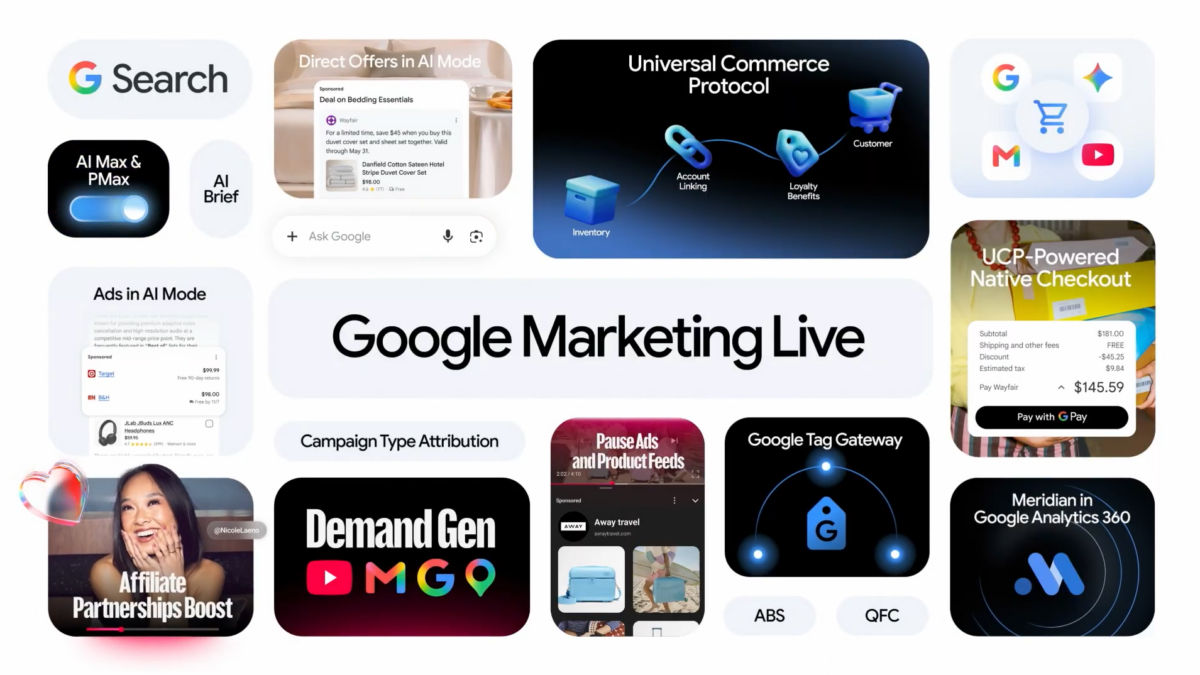
Google ran its 13th Google Marketing Live yesterday, livestreaming to more than 100 countries. Two hours, dozens of announcements, and one very clear message underneath all of it: Google wants advertisers to hand more of the execution layer over to Gemini, and the keynote spent most of its time explaining what that actually looks like across Search, YouTube, commerce, creative, and measurement.[1] Philipp Schindler, Google’s Chief Business Officer, opened with a claim about pace rather than products: [2]
“I’m not exaggerating when I say we have made a decade’s worth of innovation in the last year alone.”
That framing carried through every segment. Search Engine Land put the day in one line: Gemini is no longer just powering features. It’s becoming the operating system behind Google’s advertising, commerce and measurement ecosystem.[3] I think they’re right, and the rest of this article is mostly about what “operating system” means in practice.
Table of Contents
The Google I/O 2026 lead-in
GML didn’t happen in isolation. Google I/O ran the day before, on 19 May, and the consumer-facing announcements there set up most of what advertisers saw on stage 24 hours later.[4] The macro numbers Sundar Pichai shared are the context for everything else. Google now processes 3.2 quadrillion tokens per month across its surfaces. That’s seven times year-over-year growth. AI Overviews has 2.5 billion monthly users. AI Mode, one year after launch, has hit one billion. The Gemini app sits at 900 million monthly users, more than double its 400 million figure from I/O 2025.[4]
Gemini 3.5 Flash, the new default model in AI Mode, runs output tokens four times faster than comparable frontier models at less than half the price.[4] When AI inference gets that cheap, running Gemini-mediated ad generation on every shopping query stops being an experiment and starts being the default. Most of what landed at GML the next day is downstream of that economic shift.
Three I/O announcements matter most for advertisers. Gemini Spark is Google’s consumer agentic AI agent, and it will operate inside Chrome later this summer as an agentic browser. Gemini Omni Flash is the multimodal generation model behind Asset Studio’s new video capabilities. Antigravity 2.0 is the standalone agent orchestration platform underneath Ask Advisor. Spark is the one I keep coming back to. A Chrome-resident agent that can compare prices and check out across merchants without ever loading a comparison page is the kind of thing that quietly rewrites a lot of assumptions about how shopping queries work.
Search: Ads in AI Mode and the new conversational formats
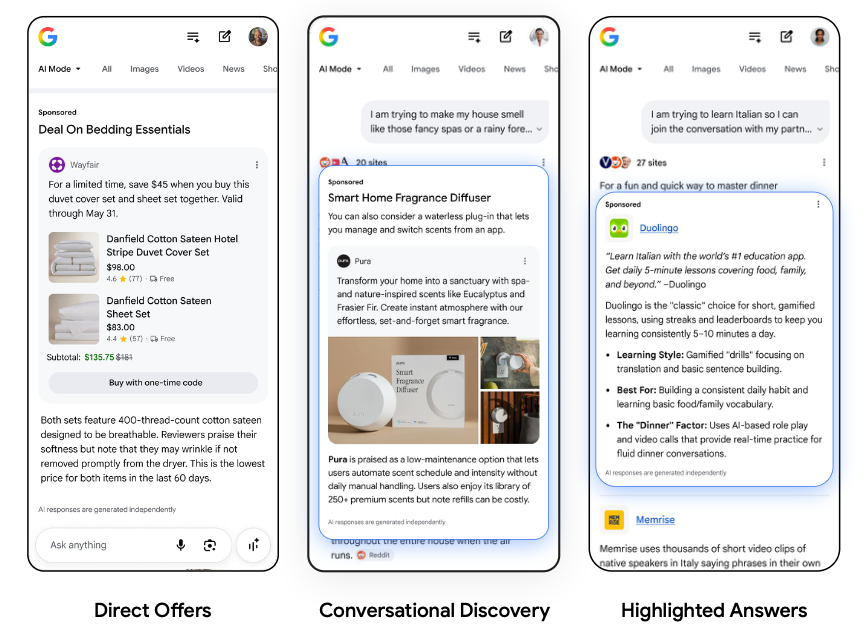
Search was the centrepiece of the keynote. Vidhya Srinivasan, VP of Ads, summarised the shift in one line that PPC Hero pulled out as their headline quote: “We’re not just showing your ads. We’re framing your product as the answer.”[5]
Schindler said in his keynote that searches in AI Mode have been doubling every quarter since launch.[5] Four new Gemini-generated ad formats arrived to meet that demand, all designed to live inside AI-generated answer flows rather than alongside them. Conversational Discovery ads generate creative tailored to a user’s specific question. Google’s demo was a search for “ways to make my home smell like a spa”, and Gemini produced creative highlighting product features for that exact intent. Highlighted Answers place ads within the AI-generated recommendation lists, not next to them. AI-powered Shopping ads generate a custom explainer per shopper for high-consideration purchases like TVs and appliances. Business Agent for Leads replaces static lead-gen forms with a Gemini-powered brand agent trained on the advertiser’s website.[6]
All four launch US-first (Business Agent also pilots in UK, India, and Canada), and all require AI Max or Performance Max as the underlying campaign type.
A different way to think about what this means
Kirk Williams, founder of ZATO Marketing and one of the more thoughtful voices in paid search, posted a useful reframe on LinkedIn during the event:
“AI Overview prompts and Searches on Google are not the same (no matter what Google says). I increasingly see these as two distinct, complementary channels operating at different stages of the customer journey, but in the same platform. Conversational queries in AI Overviews function as a top-to-middle-funnel ‘Discovery Engine,’ requiring brands to leverage automated, signal-based targeting to influence users during complex, conversational brainstorming. Traditional search still maintains a place as the more bottom-funnel ‘Transaction Engine,’ where the surgical precision of keyword-driven targeting is still essential for efficiently capturing high-intent users ready to buy.”[7]
Williams added a second observation that I think is genuinely new. Longer, more conversational queries used to be the bottom-funnel signal. More words meant more intent, closer to purchase. With AI Mode, that’s flipping. Long, conversational queries are now upper-funnel exploratory queries. The short transactional keyword is becoming the closer-to-purchase signal.
If that pattern holds, the keyword isn’t dead. It just got demoted to a different stage of the funnel. AI Max and Performance Max do the discovery work; classic keyword-driven Search Ads do the harvesting. Read alongside Google’s auction-mechanics evolution, which I covered in more detail in The History of the Google Ads Auction Mechanics, Williams’ framing is one of the cleaner mental models I’ve seen for organising the next 12 months of campaign strategy.
AI Brief: prompting your campaigns in plain language
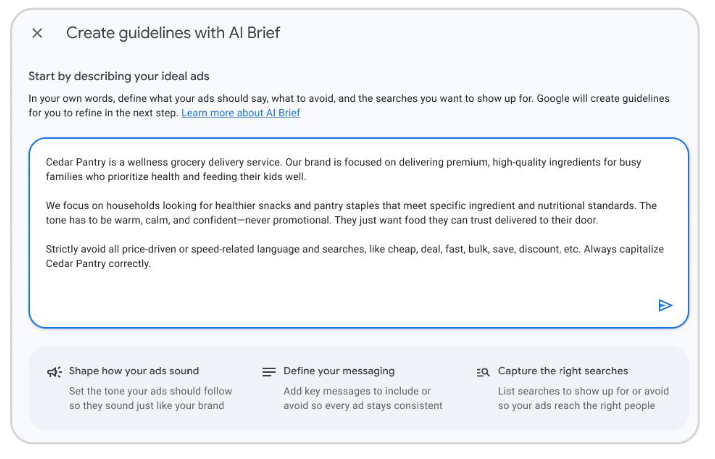
If there’s a single announcement at GML 2026 the industry will still be talking about in October, it’s AI Brief. Brainlabs called it “easily the top dog of this year’s new product releases,” and I think they’re right.[8]
AI Brief is a new way to guide AI Max (and eventually Performance Max and AI Max for Shopping) using natural language rather than settings and toggles. You write a description of your brand, your audience, what to say and avoid, the tone you want. Google uses that as context across three layers. Messaging Guidelines tell Gemini what your ads should and shouldn’t say (“never mention prices”). Matching Guidelines set boundaries on the searches you want to capture or avoid (“avoid in-person degrees”). Audience Guidelines let you serve tailored messages to specific segments (“for health-conscious people, highlight our clean products”). Once you’re done, AI Brief shows you sample assets and searches so you can verify direction before committing.[9] Global at launch in English, with more languages to follow.
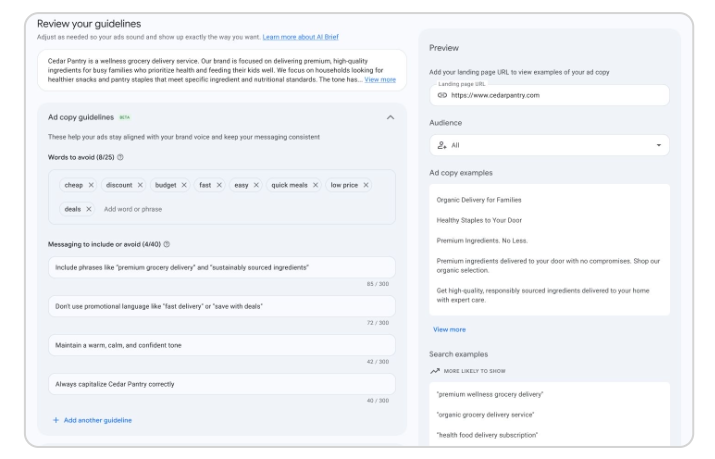
Brainlabs made the point that really matters. For years, Google’s pitch around AI has been twofold: it accelerates performance, and it frees up your time for “more strategic work.” What’s never been clear is what that strategic work actually is. AI Brief finally creates a direct line between an advertiser’s ability to articulate their brand proposition and the performance they get back. Brief-writing becomes a real, learnable skill for paid search practitioners.[8]
There’s a second implication that hasn’t been talked about much yet. If AI Brief lands as a campaign-level setting, you’ll be able to A/B test different overarching brand propositions, not just different ad copy variations. That’s a question of strategic value to any business: which proposition resonates best in the market? Google Ads has never let advertisers test that directly before.
The rest of the Search announcements
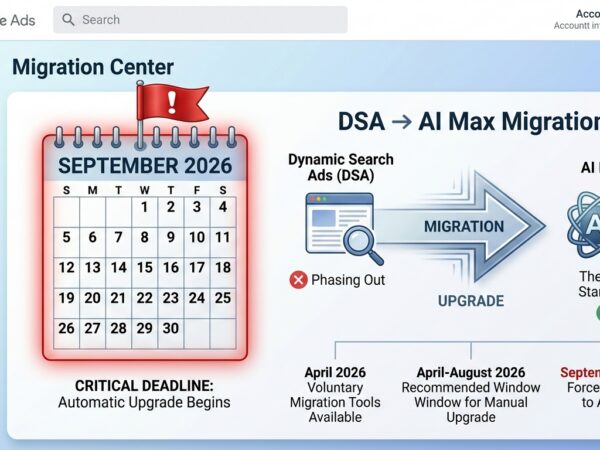
AI Mode and AI Brief got most of the stage time, but the Search section was packed. AI Max for Search officially moved out of beta, with two notable additions: AI Brief integration and text disclaimers, a new asset type that auto-appears in the first description line of your RSAs and (unlike pinning) works with Final URL Expansion. That removes the longstanding pain point for advertisers in regulated industries who couldn’t use FUE without losing compliance copy. Google’s quoted performance number at GA: 7% conversion uplift at similar CPA/ROAS when text customisation and FUE are enabled on top of search term matching.[9] If you’re still running Dynamic Search Ads, the September auto-upgrade is coming, and the playbook is in How to Migrate DSA to AI Max Before September 2026.
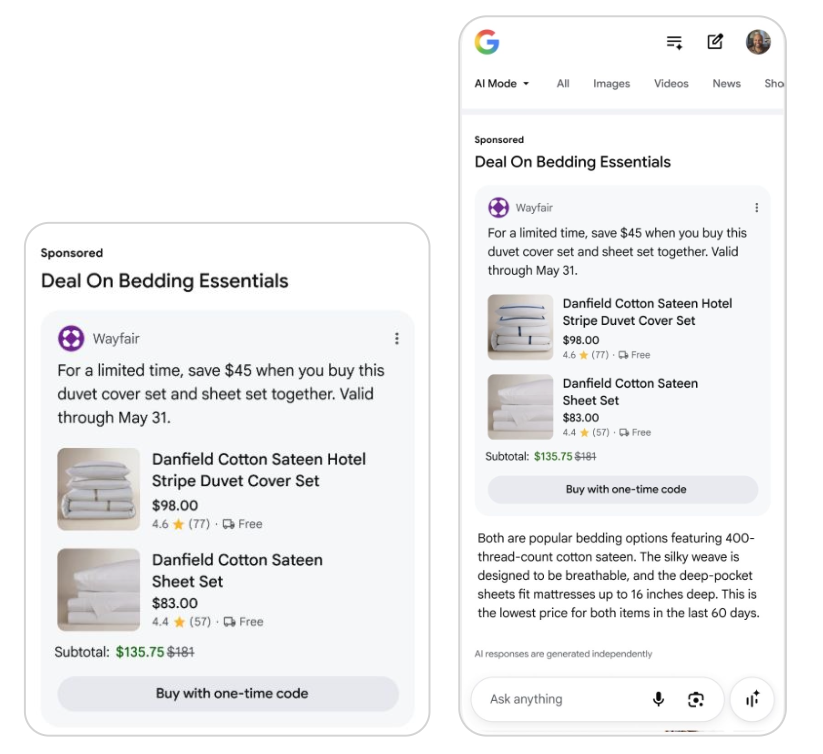
Direct Offers expanded with AI-generated promotional bundles, native checkout for UCP merchants, travel deals with Booking and Expedia, and native creation inside the Google Ads UI for AI Max and PMax advertisers. US pilot only. Search campaigns for travel brought Travel Promotion Ads, Booking Links, and travel feeds into the Search ecosystem via AI Max (global beta, all languages). Smart Bidding Exploration extended to Shopping with 27% more unique converting users in Google’s quoted data. Campaign total budgets let you set a fixed total spend across a defined date range (66% reduction in manual budget adjustments per Google). New Customer Acquisition modes added a new beta called new prospects mode, which targets users who’ve never searched for your brand, never visited your site, never engaged with your content. Demand-led budget pacing auto-shifts spend toward peak-demand days within your monthly cap.[9]
Lead-gen got more attention than usual. Improved click-to-call ads use Gemini to score leads based on what was actually said on the call, not just call duration. Message Ads with RCS for Business move users from a Search Ad into a verified text thread inside their messaging app. Journey-aware bidding lets Target CPA campaigns learn from every conversion goal across the lead journey. Leads in Google Ads adds a built-in lightweight CRM that centralises Google-hosted form leads for prioritisation and bidding.[9] Also generally available: Missed opportunity reporting, which visualises lost conversion volume due to budget or bid constraints, with an integrated “Recommended Action” column. Brainlabs’ verdict based on beta access: helpful for quick overviews, not game-changing.[8]
Commerce: Universal Commerce Protocol expands
The Universal Commerce Protocol (UCP) was announced at I/O the day before. At GML, Google expanded it materially. Universal Cart now supports Nike, Sephora, Target, Walmart, Wayfair, plus Shopify merchants Fenty and Steve Madden.[10] The Shopify inclusion is the structurally important detail. Shopify is the dominant non-Amazon retailer platform globally, and its plumbing into UCP means the protocol is no longer a Nike/Walmart bilateral integration. It’s a cross-platform commerce layer.
Three further expansions landed. Affirm and Klarna BNPL directly inside Google Pay (the first buy-now-pay-later productisation for UCP-powered checkout). UCP in YouTube Shopping ads (confirming Brandcast 2026’s “Buy with Google Pay on CTV” announcement is now bookable). Vertical expansion into hotel booking with Amadeus, Booking.com, Expedia, Hilton, Marriott, Trip.com, Accor, Choice, IHG, and Wyndham, and food delivery with DoorDash, Square, Toast, and Uber Eats. UCP becomes a cross-vertical commerce protocol rather than a shopping-specific one.[10]
Geography matters. Most UCP features roll out US-first, with Canada and Australia “soon” and the UK “later this year.” No Nordic or EU markets are in any announced wave. For European advertisers, that’s 12 to 18 months of preparation runway.
The rest of commerce
Conversational Attributes, a set of new product-data fields in Merchant Center including Question & Answer, Additional Variants, Popularity Rank, Related Products, and Item Group, let retailers add structured data that Gemini uses to match products to conversational queries across AI Mode and Gemini. This rolls out globally. For European advertisers, it’s the most immediately actionable lever from GML 2026. Feed-side preparation can start now, before any US-gated ad formats become locally available.[9]
AI Max for Shopping campaigns brings AI Max’s text customisation, Final URL Expansion, and optimal format selection to Shopping via a one-click toggle. Brainlabs flagged the open question: AI Max for Shopping and Performance Max are now structurally doing similar work. Both capture conversational, long-tail queries that standard Shopping can’t reach. Google hasn’t shipped a clear framework for when to use which.[8] Until they do, test AI Max on Shopping campaigns where you have a clean baseline and treat the PMax overlap as genuinely open.
Product Value Adjustments let you apply multipliers to conversion values of specific products without restructuring campaigns. Useful for upweighting high-margin SKUs, deprioritising returns-prone products, or clearing overstock. AI Performance Insights measures “share of voice” against competitors across AI surfaces (US/CA/AU/IN/NZ only). Commerce Media Suite added SKU-level reporting in DV360, cross-retailer reporting in SA360, in-store reporting and bidding, and the ability to safely share first-party data segments with brand partners. New visual-rich Search formats rolled out for Discover, Image Search, and Google Lens.[9]
Ask Advisor: one chat interface across the Google ad stack
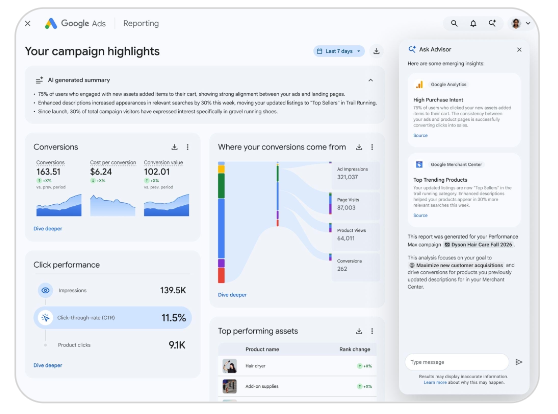
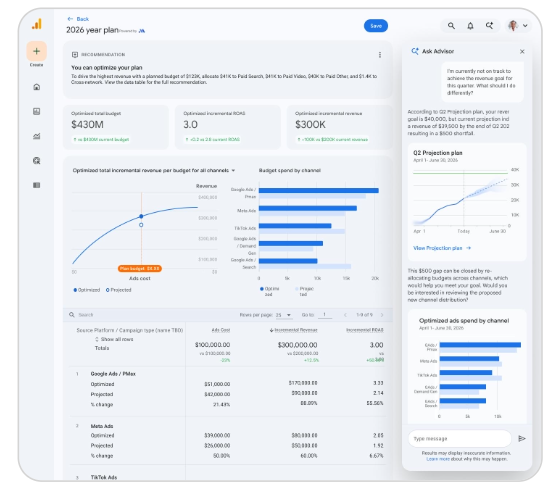
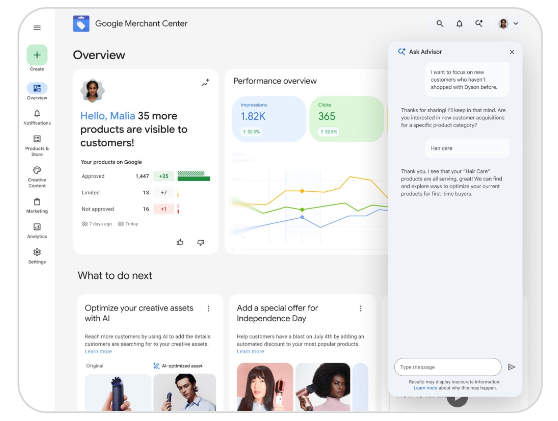
Ask Advisor is the agentic conversational interface that spans Google Ads, Google Analytics, Google Marketing Platform, and Merchant Center. By connecting specialised agents embedded in each piece of the ecosystem, it gives advertisers a single entry point for analysing strategy from a holistic perspective.[11]
Brainlabs’ framing of why this matters is sharp: “Google has been working to build this conversational functionality into ads management for nearly three years, but the current conversational interfaces are isolated within each portion of the ecosystem. By providing a new entry point for us to engage with all of these pieces at once, Google is meeting advertisers where they operate today, in a chat experience powered by connected agentic advisors.”[8]
Knowledge work has shifted in the last two years. A lot of marketers (me included) now arrive at the desk with a Claude or ChatGPT window already open. We brief AI in plain language, use it to shape messaging, test creative concepts, work through audience strategy. Ask Advisor is Google’s recognition that this is how marketers actually work now, rather than asking us to relearn a different interface every quarter.
The Ask Advisor family is spreading across the entire stack. Google Ads, Analytics, Merchant Center, DV360, SA360, and Campaign Manager 360 each get a specialised version. The Merchant Center variant diagnoses feed issues and provides a roadmap to improve your Store Quality Score. The Analytics version generates AI dashboards from natural-language questions. The Ads version creates Performance Max campaigns from scratch, troubleshoots policy violations, and offers personalised bid recommendations you can apply in one click.[9] Most launch in English first.
Asset Studio: Gemini-powered creative at scale
Asset Studio is being rebuilt as a unified creative workspace inside Google Ads. You generate, test, and manage creative assets using Google’s most powerful AI models. The 2026 update introduces multimodal capabilities: advertisers can generate images and video by describing what they need in plain language, pulling in existing brand materials and marketing briefs to keep output on-brand. There’s also a one-click A/B testing flow built directly into the creation process.[11]
The model powering it is Gemini Omni Flash, confirmed for Google Ads this summer. Asset Studio is the interface; Gemini Omni Flash is what makes “infinite creative” function in practice. Three pieces matter for advertisers. You can upload marketing briefs and brand PDFs that anchor the style and business information Gemini uses. You can pull content from Adobe and Canva directly through the Google Ads API. And asset generation is now programmatic via the API, which opens the door for agencies and developers to build on top of it.[8]
Brainlabs’ honest read, based on running the existing version with clients: the 2025 version of Asset Studio struggled to live up to the pitch. What would make the 2026 version genuinely exciting is consistency in the quality of generated assets, plus the video capability at campaign scale, which would be net new. One-click A/B testing is the underrated piece. Most advertisers either skip creative testing entirely or run it too informally to get reliable results. If Asset Studio makes structured creative experiments easy to run, that genuinely changes how creative strategy gets done.[8]
English-only at launch, rolling out globally this summer.
YouTube and Demand Gen: full-funnel, finally
Demand Gen was the campaign type Google spent the most time defending and expanding. The repositioning from upper-funnel awareness to full-funnel performance has been telegraphed for a while. GML 2026 made it concrete.
The headline addition is Google Maps inventory. Demand Gen campaigns can now serve into Maps surfaces (Browse, Directions, and Entity/Place Details modes). High-intent local discovery becomes a new agentic-commerce surface. Open beta, global, all languages.
Around that, a substantial supporting cast. Product feeds expansion (vehicle feeds eligible in Q3, new video link attribute in Merchant Center, expansion to YouTube Pause ads and tablets, with Google’s quoted 33% conversion lift for campaigns with large product selections). Creator videos in the asset picker (20% average conversion lift at target CPA). Multimodal Video Creation in Asset Studio (Gemini, Veo, and Nano Banana powering brief-to-storyboard-to-production). AI-assisted Demand Gen campaign creation (auto-populates settings from existing PMax campaigns). Demand Gen in Commerce Media Suite (first-party retailer data across YouTube, Discover, and Gmail). Product videos at scale (removes the 5-video upload limit). Checkout Links (expanded to 9 new markets plus YouTube Shorts and in-feed ads, with 6% conversion uplift). Affiliate partnerships boost (turns existing organic YouTube affiliate content into Demand Gen ad inventory, US pilot). View-through Conversion optimisation (Demand Gen can now optimise toward VTCs alongside click-based conversions, open beta global).[9]
Two measurement-focused additions for Demand Gen are worth flagging separately. Demand Gen Uplift Experiments gives advertisers an automated A/B testing framework to prove incremental impact when added to PMax, Video, Display, and App campaigns (10% higher ROAS and 12% higher sales effectiveness in Google’s data). Campaign Type Attribution isolates all Demand Gen conversions from other Google campaign types, enabling apples-to-apples comparison with paid social. Brainlabs called this one of the most practically useful announcements, because the biggest blocker to Demand Gen budget growth has been the inability to benchmark it on terms a paid social buyer recognises.[8]
Measurement: Meridian, QFCs, and the shift to incrementality
Measurement got significant updates. Google’s framing throughout was consistent: as attribution fragments and privacy restrictions expand, the industry needs to move toward predictive incrementality modelling rather than deterministic last-click attribution.
Meridian into Analytics 360 is the headline. Google is integrating its open-source marketing mix modelling platform directly into Analytics 360 for unified first-party and cross-channel data, incrementality measurement, campaign outcome forecasting, and media mix optimisation.[12] The full package includes Meridian-powered budgeting, Data Manager in Google Analytics, enhanced Multi-Touch Attribution inclusive of third-party impression data from Meta, TikTok, Snap, and Pinterest, and Incremental Conversions Reporting that harmonises incrementality, MMM, and MTA into a single view. Meridian GeoX is a new open-source geo-incrementality solution, and Meridian Studio is the Google Cloud-built UI version in pilot from July through December.[9]
Qualified Future Conversions is the most novel measurement piece. It’s an AI-powered metric that predicts the long-term revenue impact of upper-funnel campaigns by connecting initial ad exposure and leading user actions (branded search, engaged visits) to expected future conversions.[12] Pilot, global, all languages, no custom tagging required. Over time, QFC insights feed back into Meridian to improve predictive modelling accuracy.
The competitive positioning around all of this is becoming clearer. Google is betting on predictive AI-augmented measurement. Microsoft, at Activate 2026, is betting on transparent advertiser-controlled reporting. OpenAI, which I covered in more depth in ChatGPT Ads in 2026: Everything Advertisers Need to Know, is betting that conversational AI itself becomes the new front door to commerce. GML 2026 is best read as Google’s competitive response to both.
Data Manager, Google Tag Gateway, and the data-strength push
Brainlabs spent considerable time on Google Tag Gateway, and they’re right to. GTG routes your tag signals through your own domain’s server rather than through Google’s infrastructure directly. The practical effect is better data accuracy, higher match rates, and first-party data more resilient to browser-level tracking restrictions. Google’s numbers: 14% conversions uplift on average, up to 7% lower cost per acquisition when used alongside enhanced conversions. The key change at GML is that adoption barriers have dropped significantly. GTG can now be implemented with one-click integrations across Google Cloud (beta), Fastly, Akamai, Webflow, Duda, and Cloudflare.[8] Pilot, US/CA, English.
Data Manager became universal across Google Ads, Search Ads 360, and Campaign Manager 360, with new direct integrations including Mailchimp, ActiveCampaign, Klaviyo, and Google Drive. Google’s claim: a 26% average increase in incremental ROAS for advertisers who connect offline and app data through it.[9] Generally available, global. The rest of the measurement updates round out the picture. Enhanced Conversions consolidated. Google Tag Manager added visual tagging. Attributed Branded Searches went GA with AI Mode support coming. Lead Intent Scores and Lead Journey Mapping landed (US/CA pilot and global pilot respectively). Store Sales got broader availability with reduced traffic thresholds.
Apps: iOS measurement and App Connect
Apps got less stage time than commerce or measurement, but the updates matter for app advertisers. App Connect (formerly Web-to-App Connect) is now a unified suite treating web and app as equal partners, with agentic implementation workflows for tracking, bidding, and deep linking. Google’s quoted number: 2.8x higher conversion rate for clicks landing in your app versus your mobile site. iOS App campaign advancements include on-device conversion measurement, Integrated Conversion Measurement expansion to EEA, UK, and Switzerland, and an expanded bidding suite. Deep link agent in App Links Assistant uses AI to automate in-app deep link creation inside Android Studio. What was traditionally a multi-day implementation now takes minutes.[9]
What advertisers should actually do now
Most of the consumer-facing surface at GML 2026 is US-gated or English-only at launch. That’s the honest read. But the feed-side and measurement-side updates are global, and they’re the foundation everything else depends on. Five concrete priorities for advertisers outside the US:
- Prepare your Merchant Center feed for Conversational Attributes. Global rollout means this is actionable today. Question & Answer, Additional Variants, Popularity Rank, Related Products, and Item Group all become Gemini matching signals once AI Mode formats expand into your market.
- Migrate from DSA to AI Max before September 2026. If you’re still running Dynamic Search Ads, the September auto-upgrade lands six weeks before Black Friday. AI Max is the campaign type most of the GML 2026 conversational formats are served through. The full playbook is in How to Migrate DSA to AI Max Before September 2026.
- Sign up for AI Brief beta and start learning to brief. Whether your account is in the first wave or not, brief-writing is going to be a real skill in 2026. The advertisers who can articulate their brand proposition cleanly will get measurably better Gemini-generated output than the ones who can’t.
- Test Google Tag Gateway. If you’re in a market where it’s available, it’s one of the lower-effort, higher-impact infrastructure upgrades on the list. The data-quality gap between early adopters and late movers is about to widen.
- Watch for the Gemini Spark agentic browser. Spark in Chrome later this summer is the consumer-side primitive most likely to quietly rewrite assumptions about how shopping queries work.
Where this leaves us
GML 2026 wasn’t a feature release. It was the moment Google stopped pretending that AI was one capability among many in its advertising stack and started treating it as the substrate everything else sits on top of. Six Gemini-as-layer products in 30 days, depending on how you count: Ads Advisor, in-Ads Gemini dashboards, Ask Advisor, Asset Studio with Gemini Omni, Conversational Discovery ads, and Meridian with Qualified Future Conversions.
Brainlabs’ read of the broader pattern is the one that’s stuck with me most: “Google is giving advertisers agentic AI-powered solutions to manage campaigns. Google is also giving advertisers more data and better conversion tracking. Now we get to experiment with these new features to discover which are the best solution for each specific business challenge.”[8]
Jyll Saskin Gales’ summary, recorded immediately after the event, captures the working reality for most of us: “The future is now. At least the vision for the future is now. The challenge, of course, is that many of our businesses are not quite ready for that yet. And the Google Ads product itself is not quite ready for that yet.”[13]
That’s about right. The most useful framing isn’t whether GML 2026 is overhyped or correctly hyped. It’s that the gap between Google’s roadmap and what your account can actually do today is now a strategic question on its own. Advertisers who treat this as a routine GML recap will be six months behind the ones who treat it as the platform shift it actually is. The work you do between now and Black Friday is what decides which group you end up in.
Sources
- Google Marketing Live 2026: every announcement that actually matters, PPC Land. https://ppc.land/google-marketing-live-2026-every-announcement-that-actually-matters/
- Google Marketing Live 2026 keynote, Google (livestream). https://www.googlemarketinglive.com/digital/US-2026
- Google Marketing Live 2026: Everything you need to know, Search Engine Land. https://searchengineland.com/google-marketing-live-2026-everything-you-need-to-know-478167
- I/O 2026 Keynote — Sundar Pichai: Welcome to the Agentic Gemini Era, Google Blog. https://blog.google/innovation-and-ai/sundar-pichai-io-2026/
- Google Marketing Live Key Takeaways: What the PPC Industry Needs to Know for 2026 and Beyond, PPC Hero. https://ppchero.com/google-marketing-live-key-takeaways-what-the-ppc-industry-needs-to-know-for-2026-and-beyond/
- Google tests new conversational ad formats in AI Mode and Search, Search Engine Land. https://searchengineland.com/google-tests-new-conversational-ad-formats-in-ai-mode-and-search-478115
- Kirk Williams on GML 2026 — AI Overviews vs traditional Search as separate funnel stages, LinkedIn. https://www.linkedin.com/in/kirkwilliamsmarketing/
- Google Marketing Live 2026: AI is the new interface, Brainlabs. https://www.brainlabsdigital.com/google-marketing-live-2026-brainlabs-review/
- GML 2026 Announcement One-Sheeters (PDF), Google. https://www.googlemarketinglive.com/digital/US-2026
- Google expands Universal Commerce Protocol and launches new agentic shopping tools, Search Engine Land. https://searchengineland.com/google-expands-universal-commerce-protocol-and-launches-new-agentic-shopping-tools-478113
- Google upgrades Asset Studio with Gemini-powered creative generation and video tools, Search Engine Land. https://searchengineland.com/google-upgrades-asset-studio-with-gemini-powered-creative-generation-and-video-tools-478112
- Google brings Meridian marketing mix modeling into Analytics 360, Search Engine Land. https://searchengineland.com/google-brings-meridian-marketing-mix-modeling-into-analytics-360-478110
- Inside Google Ads Special Episode 121: Google Marketing Live 2026, Jyll Saskin Gales. https://jyll.ca/insidegoogleads/121