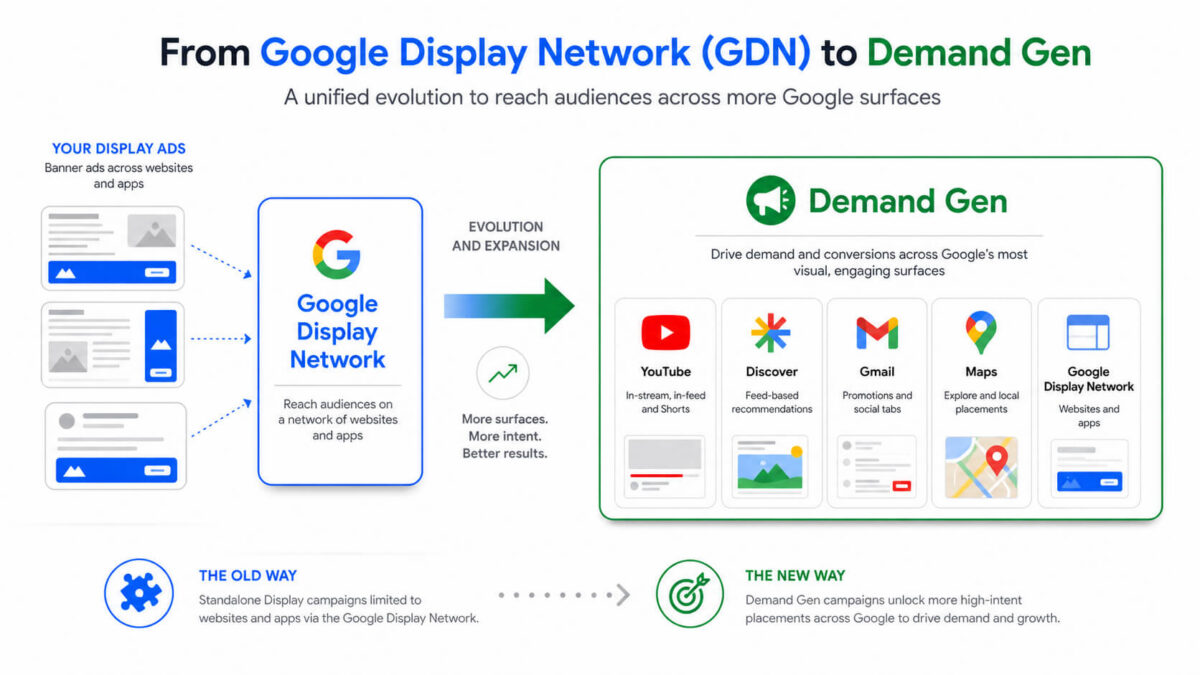
On May 26, 2026, Google announced that Display advertisers can manage Google Display Network inventory directly inside Demand Gen campaigns, with the option to keep serving exclusively on GDN if that is what they want [1]. The announcement is written as a convenience upgrade. Read alongside what happened six weeks earlier, it is something else: the second forced migration of the quarter, and confirmation that Google is collapsing single-purpose campaign types into AI-native multi-surface containers.
The first was Dynamic Search Ads folding into AI Max in April, covered in the DSA to AI Max migration playbook. The mechanics differ, but the shape is identical: a campaign type with narrow controls gets absorbed into a broader container that optimises across more surfaces with fewer levers. Anyone who ran the DSA migration already knows what the friction feels like. This is the same pattern applied to Display.
Table of Contents
What Google Actually Announced
The functional change is that GDN inventory becomes manageable from inside Demand Gen rather than from a standalone Display campaign. Google frames this as more streamlined campaign management [1]. Advertisers who want GDN-only delivery can still configure it, so nothing about reach disappears on day one.
What changes is the container. Demand Gen now serves across five surfaces: YouTube, Discover, Gmail, Maps, and the broader Display Network of roughly two million sites and apps [3]. Display is no longer a campaign type sitting beside Demand Gen. It is a surface inside it.
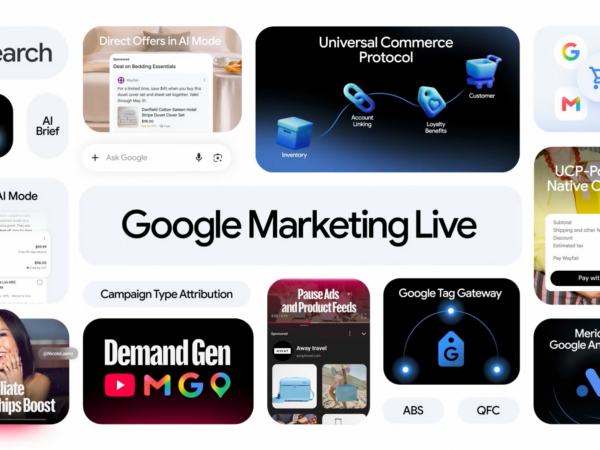
Migrating also unlocks the Demand Gen features announced at Google Marketing Live 2026, including the expanded channel controls and the AI campaign capabilities that shipped with them [3]. This is the part that shapes the timing question. The features are gated behind the migration, so staying on standalone Display is not holding a stable position. It is falling further behind the roadmap.
Why “Retirement” Is the More Accurate Word
Google’s headline calls it a new home. Search Engine Journal called it a retirement of standalone Display campaigns, and that framing has held up better [2]. The distinction is not semantic. A new home implies the old one remains habitable. A retirement tells you to plan for its absence.
Search Engine Land read the same announcement as part of a broader push toward unified, AI-driven campaign structures, noting that advertisers may need to rethink how they separate upper-funnel discovery, Display, and performance-focused buying [3]. That is the bigger point. Where GDN inventory gets administered matters much less than whether the distinction between “Display” and “discovery” survives as a working category at all.
Three independent write-ups landed within a day of the official post. All three read it as a deprecation [2][3][4]. When the vendor’s framing and the practitioner framing diverge that cleanly, plan against the practitioner one.
What You Lose: Granularity, Exclusions, and Reporting
The losses cluster in four places, all flagged in the day-one coverage: GDN inventory management, exclusions, reporting, and campaign controls [2]. Each one needs an answer before you migrate, not after.
- Placement control. Standalone Display let you manage where ads ran across GDN at a fine grain. Inside a container optimising across five surfaces, those decisions move further under automation. Accounts that spent years building placement exclusion lists are the most exposed, because those lists are accumulated knowledge and the new container may not inherit all of it.
- Exclusions. Related but not the same thing. Brand safety lists, topic exclusions and content label settings are what make GDN usable at all for a lot of regulated advertisers. Check each one transfers, and that it still bites at the level you need, before you move budget.
- Reporting. Display reporting has been unusually legible. You could see which placements ate the budget. Multi-surface containers have historically reported at a coarser grain. If your current reports answer a question a client asks every month, make sure you can still answer it afterwards.
- Campaign controls. The catch-all: bid modifiers, targeting settings and structural choices that exist in Display and may have no equivalent in Demand Gen.
The trade is control for reach and automation. Whether it is a good trade depends on one question: was the control actually producing anything? Accounts where placement exclusions and hands-on inventory management were genuinely moving results will feel this as a downgrade. Accounts that kept those controls out of habit will barely notice they are gone.
What You Gain: Five Surfaces and a Feature Backlog
The gains are real. A migration analysis that only lists losses is no help when you have to decide what to actually do.
- Maps as inventory. Demand Gen now connects to local audiences through Google Maps placements [5]. For retailers with physical locations, this is the first time a single mid-funnel bid can reach in-Maps intent without standing up a separate campaign type.
- Product feeds, including new verticals. Google reports that advertisers with large product selections typically see a 33% increase in conversions when adopting product feeds in Demand Gen campaigns [5]. Feed support has also expanded beyond retail into automotive [5].
- View-through conversion optimisation. Demand Gen campaigns can now optimise for view-through conversions on YouTube [6]. This closes a parity gap with competing platforms where view-through has been a default optimisation signal for some time, and it matters for a channel whose main contribution is often non-clicking.
- New-customer performance. Google states that Demand Gen drives an 18% higher share of conversions from new customers compared with the paid media average [6]. If new-customer acquisition is an actual target rather than a reporting line, that figure argues for the channel independently of the migration.
Creative built for multiple aspect ratios is the other structural gain, though it arrives as a cost first. Demand Gen wants vertical, square and horizontal assets. That is more production work than a Display campaign ever asked for. It is also the reason one campaign can serve Shorts, in-feed and Discover without the creative looking borrowed from somewhere else.
The 9.5% ROI Claim, Read Carefully
Google says advertisers adding GDN inventory into Demand Gen see an average 9.5% increase in ROI [3]. It is the only quantified claim attached to this migration, which guarantees it will turn up in every internal deck arguing about when to move. It deserves more scrutiny than it usually gets.
Three things about it. It is vendor supplied and nobody has audited it. It measures advertisers who chose to add GDN inventory before anyone made them, which describes self-selected early adopters, the accounts with spare creative capacity and decent measurement, rather than the migration cohort as a whole. And 9.5% is a modest number for a change this size. It is not a figure that makes migrating urgent on performance grounds.
So treat 9.5% as evidence the migration probably will not hurt, not as a forecast for your account. The reason to migrate on purpose is that the deadline is not yours to set and the features are gated behind it. The ROI claim is not the reason.
The Migration Checklist
Five steps, in this order. The sequence matters more than the individual items, because two of them get much harder once budget has moved.
- Audit the Display account before anything moves. Export the placement exclusions, topic and content label exclusions, audience configurations, and ninety days of placement level performance. This is the step people skip. It is also the only one that becomes impossible later, because once campaigns are migrated the baseline you would have compared against no longer exists.
- Set distinct conversion goals from the start. Demand Gen should optimise toward soft conversions — add-to-cart, newsletter signup, or clicks — while Performance Max keeps the hard purchase goal. The reasoning is in the next section, and getting this wrong is the single most expensive mistake available in this migration.
- Rebuild creative for multiple aspect ratios. A working Demand Gen set needs horizontal, vertical and square coverage in both video and static, plus several headlines and descriptions. Assets built for GDN banner slots will not carry a Shorts placement. This is the real cost of migrating, and the most common reason early results look bad.
- Fix the signal layer. Server side web signals through Google Tag Gateway, CRM and offline conversions through Data Manager, Enhanced Conversions for measurement integrity. A container optimising across five surfaces leans on signal quality far harder than a campaign you steered by hand. Weak measurement costs more after this migration than it did before.
- Decide the view-through question up front. View-through optimisation is available now [6], so settle before launch whether view-through conversions count in your reporting and over what window. Leave it until later and you will be arguing about attribution while the campaign is already spending. That is how upper funnel budgets get cut for the wrong reasons.
The Failure Mode: Demand Gen Behaving Like Performance Max
This is the part that decides whether a migration works, and it has nothing to do with inventory settings.
A feed-based Demand Gen campaign optimised for hard purchase conversions starts competing for the same audience as Performance Max. Both then chase the same users toward the same goal. What follows is predictable: bidding pressure against yourself, rising costs on the overlapping audience, and a Demand Gen campaign that will not scale because the cheap conversions are already being claimed elsewhere. It is easy to miss, because each campaign looks perfectly reasonable on its own screen.
The fix is structural, not tactical. Give the two campaign types different conversion goals and different KPIs. Demand Gen optimises toward soft conversions and gets judged on reach, new customer share and downstream branded search. Performance Max keeps the purchase goal and gets judged on ROAS. If both optimise for purchases you have built the same campaign twice, and the migration will look like the thing that failed when the account structure is what failed.
Splitting remarketing and prospecting into separate Demand Gen campaigns is worth the extra maintenance for the same reason. Different jobs, different economics. Average them and you get a number that describes neither.
Reframing Demand Gen as Inventory, Not Awareness Spend
The argument for this channel gets much easier to make once the accounting frame changes. A Demand Gen impression nobody clicks today is a potential high intent searcher a few weeks from now. The contribution is real, just lagged. Cut Demand Gen and it shows up in Search impression share and branded query volume roughly six to eight weeks later, not straight away [7].
That lag is what makes the channel politically fragile. Lower funnel ROAS is easy to defend to a finance team. A channel that pays off in six weeks is easy to cut, and the cut looks free for the first month and a half. The damage arrives a quarter later, by which time it reads as a market problem rather than a budget decision [7].
The answer is to change the evidence, not the argument. Track branded query volume in Search Terms as the leading indicator, watch non-branded impression share trends, and review monthly at the very least. Quarterly is too slow for something with a six to eight week feedback loop; a quarterly cadence catches a declining branded search trend only after weeks of pipeline has already gone [7]. The question to ask of a Demand Gen campaign is not what the ROAS is. It is how much qualified demand it is creating for Search and Shopping to close.
Google has also shipped tooling aimed at exactly this attribution problem, including campaign-type attribution to isolate Demand Gen conversions and uplift experiments to test whether Demand Gen is additive or cannibalistic relative to Performance Max [5]. An experiment settles that question better than an attribution argument does, and it is the more defensible artifact to bring to a budget conversation. Building this kind of measurement into a repeatable routine is the same discipline described in building a PPC operating system.
Two Constraints Worth Checking First
Two things sit outside the migration itself but change the plan for specific advertisers.
Restricted targeting in sensitive categories. A June 2026 clarification spells out that restricted-targeting rules can limit reach, eligibility, and delivery in Demand Gen for sensitive categories including health, financial hardship, and personal difficulties [9]. For healthcare, insurance, or financial-services advertisers, this means audience signals that worked in Display may not serve the same way inside Demand Gen. Review targeting and audience signals against those rules before assuming planned reach, because discovering the constraint after migration looks like a performance problem rather than an eligibility one.
Shorts brand safety is no longer the blocker it was. YouTube earned MRC accreditation for short-form video, making it the first platform accredited for Shorts [8]. That matters here because the Demand Gen creative recipe pushes toward vertical assets, and vertical means Shorts. Advertisers who previously held Shorts budget back on brand-safety grounds now have independent third-party accreditation to point at, which clears a procurement objection that used to require an internal argument.
What to Do This Month
The migration is not optional in the long run, so the only decision left is whether it happens on your schedule or Google’s. The DSA to AI Max cohort showed what the second option costs. Automatic migrations land mid quarter, without a baseline, and usually without the creative the new container needs.
A workable sequence for the next four weeks. Export the Display baseline and the exclusion lists now, while they still exist. Decide the conversion goal split between Demand Gen and Performance Max, and write it down somewhere it will survive a staff change. Commission the creative early, because it has the longest lead time and gates everything else. Then migrate one campaign, not the account, and measure it against the exported baseline before you move the rest.
The pattern behind all of this is worth naming, because it will repeat. Discovery Ads went into Demand Gen. Video Action campaigns went into Demand Gen. Dynamic Search Ads went into AI Max. Standalone Display has now gone into Demand Gen. Each time, a campaign type with specific controls was absorbed into a container with fewer controls and more surfaces, and each time the advertisers who came out ahead were the ones holding a baseline, a clear conversion-goal structure, and creative built for the new format. Those three things are what to prepare, not because of this migration in particular, but because the next one will ask for them too. The same consolidation logic is playing out in agentic commerce protocols, where the container keeps getting broader and the levers keep moving up a level.
Sources
- “Google Display Ads has a new home in Demand Gen,” Google Ads & Commerce Blog, May 26, 2026. https://blog.google/products/ads-commerce/google-display-ads-demand-gen/
- Brooke Osmundson, “Google Is Retiring Standalone Display Campaigns In Favor Of Demand Gen,” Search Engine Journal, May 26, 2026. https://www.searchenginejournal.com/google-is-retiring-standalone-display-campaigns-in-favor-of-demand-gen/575889/
- Anu Adegbola, “Google folds Display Ads into Demand Gen campaigns,” Search Engine Land, May 26, 2026. https://searchengineland.com/google-folds-display-ads-into-demand-gen-campaigns-478727
- “Display campaigns migrating to Demand Gen,” PPC News Feed, May 27, 2026. https://ppcnewsfeed.com/ppc-news/2026-05/display-campaigns-migrating-demand-gen/
- “New Demand Gen and YouTube updates,” Google Ads & Commerce Blog, May 20, 2026. https://blog.google/products-and-platforms/products/youtube/youtube-demand-gen-updates/
- “Demand Gen Drop: April 2026,” Google Ads & Commerce Blog, April 23, 2026. https://blog.google/products/ads-commerce/demand-gen-drop-april-2026/
- “Stop looking for the perfect PPC budget split,” Search Engine Land, June 8, 2026. https://searchengineland.com/stop-looking-perfect-ppc-budget-split-479548
- “YouTube earns MRC accreditation for Shorts,” Google Ads & Commerce Blog, June 3, 2026. https://blog.google/products/ads-commerce/youtube-mrc-accreditation-shorts/
- “Google clarifies sensitive audience targeting rules for Demand Gen campaigns,” Search Engine Land, June 5, 2026. https://searchengineland.com/google-clarifies-sensitive-audience-targeting-rules-for-demand-gen-campaigns-479622