The most consequential thing Google shipped at I/O 2026 was not a new model and not a new ad format. It was a cart. A boring word for a piece of plumbing that, if it catches on, restructures the way every retailer in the Shopping Graph thinks about owning the customer.
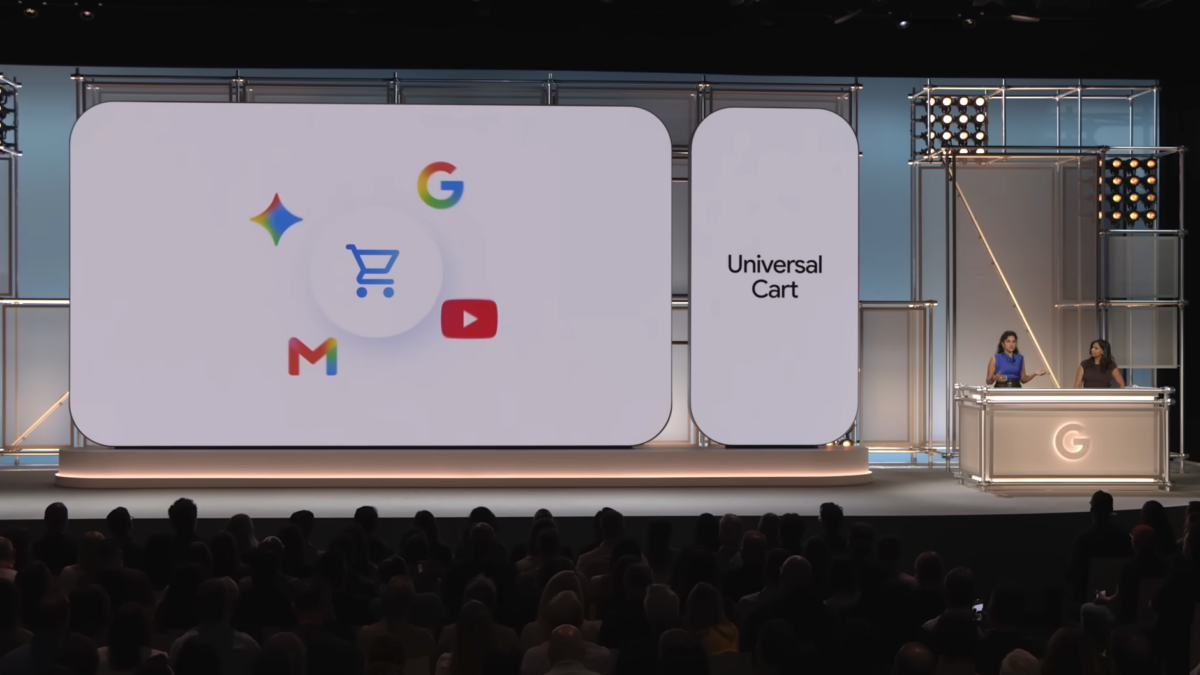
Universal Cart is Google’s single intelligent cart that follows the shopper across Search, Gemini, YouTube, Gmail, and Google Maps, holding items from many retailers at once and completing checkout without sending the buyer back to anyone’s site. Underneath that consumer-facing surface sit two open protocols that did not exist twelve months ago: the Universal Commerce Protocol (UCP) for catalog and cart, and the Agent Payments Protocol (AP2) for payments and authentication. Both are now community-governed. UCP runs on a partnership of Google, Shopify, Walmart, and 22 other ecommerce players. AP2 was donated to the FIDO Alliance in April 2026, before the Universal Cart launch, with v0.2 already public on GitHub [1].
Hold onto this one structural fact: agentic commerce in 2026 is a two-protocol architecture, and the protocols answer different questions. UCP answers what to buy. AP2 answers how to pay for it. Both are open. The moat Google is building sits one layer above, in the consumer cart and the catalog data Merchant Center already controls.
The rest of this piece walks through what each protocol actually does, why a senior SEO at a launch retailer told David Bell at I/O that the integration “feels rushed,” and what feed and merchant-setup work you can do this quarter to be ready when Universal Cart lands in your market.
Table of Contents
What Universal Cart actually is
Universal Cart launched in the US on Search and the Gemini app during summer 2026, with UCP checkout rolling out to Canada and Australia “in the coming months,” then to the UK, with new verticals including hotel booking and food delivery through AI Mode and Google Maps after that [2], [3].
The initial merchant list is small and deliberately glossy: Nike, Sephora, Target, Ulta Beauty, Walmart, Wayfair, plus Shopify-based Fenty and Steve Madden. Payment runs through Google Pay, with Affirm and Klarna embedded for buy-now-pay-later flows [3].
What it does, in the demos Google showed at I/O:
- Identifies deals and price drops on items the shopper has been considering.
- Shows price history so a shopper can decide whether the current price is actually a good moment to buy.
- Alerts on restocks for out-of-stock items.
- Aggregates loyalty programs and merchant offers across stores.
- Performs agentic reasoning at the cart level. The example Vidhya Srinivasan used on stage was a custom PC build where the cart proactively flagged incompatible components and suggested alternatives [2].
That last one is the genuinely new part. A normal cart is a list of SKUs. Universal Cart is a list of SKUs that knows what they are, where they came from, and whether they fit together. The intelligence sits in the Shopping Graph (60+ billion product listings and roughly one billion shopping sessions a day on Google) being fed through Gemini models that improve over time [2].
The catalog side of how this works hinges on a quietly significant Merchant Center update that shipped the day after I/O: conversational attributes.
Conversational attributes, the feed-side prerequisite
On 20 May 2026, Google Merchant Center rolled out six new optional attributes designed to help AI systems understand product data. Hana Kobzová surfaced them in PPC News Feed [4]. They are available via supplemental data sources or the Merchant API, and adding them does not affect existing approval status. A deliberate “just turn them on” design.
The six attributes:
- question_and_answer — answers to the product questions shoppers ask most.
- document_link — URLs to authoritative product documentation, including PDFs of user guides, manuals, and assembly instructions.
- related_product — accessories, spare parts, substitutes.
- item_group_title — common title across variants (paired with item_group_id).
- variant_option — variant identifiers as name/value sub-attributes.
- popularity_rank — popularity expressed as a percentile of total inventory (0.0–100.0).
These are not cosmetic. Two of them are quietly load-bearing for Universal Cart’s “smart” behaviour.
document_link is how the PC-compatibility demo actually works. If the agent can read the spec sheet for a graphics card and the spec sheet for a power supply, it can warn the shopper when the wattage is wrong. Without document_link, that reasoning collapses into “trust the title and the structured data, hope nothing breaks.”
popularity_rank is the merchant-supplied signal Google can use to rank within an agent’s consideration set without leaning entirely on its own click-through history. It is also the field most likely to be gamed first.
The other four (Q&A, related product, variant grouping) fill in the gaps that long-form product detail pages have always carried but that nobody wired into structured feeds. The era where keywords mattered and attributes were optional is over. The smec explainer put it bluntly back in February: in a UCP world, keywords are dead and attributes are king, and missing fields like material_origin, care_instruction, or native_checkout mean the agent disqualifies your product from negotiation entirely. Not just lowers your Ad Rank [5].
That framing was speculative in February. The Merchant Center conversational-attributes release is what makes it operational. If you have not opened that help page yet, do it before you finish this article.
AP2, what changes when the payment leg goes open
The second protocol is the one most retailers have not read yet, partly because it was donated quietly a month before the Universal Cart keynote.
On 28 April 2026, Google transferred ownership of the Agent Payments Protocol (AP2) to the FIDO Alliance, the same standards body responsible for passkeys and WebAuthn [1]. At the same time, AP2 v0.2 went public on GitHub with several substantive additions:
- Human Not Present payments. Agents can execute transactions independently, based on user pre-authorization. The illustrative example in Google’s announcement was an agent buying limited-edition tickets the second they go on sale. The user is not at the keyboard. The agent is acting on a standing mandate.
- Verifiable Intent. A new standard, co-developed with Mastercard, that creates an auditable record of which user authorised which agent to do which thing on which terms. Also being donated to FIDO.
- User controls. The shopper can set spending limits and specify which brands or products an agent is allowed to buy from [2].
“Human Not Present” is qualitatively new. A 3-D Secure step-up, a Strong Customer Authentication re-prompt, an Apple Pay biometric check. Those are all designed around the assumption that a human is there to confirm intent at the moment of payment. AP2 starts from the opposite assumption: the human gave consent earlier, the agent acts later, and the audit trail has to reconstruct the chain of authorisation after the fact. That is a different security model, and the fact that Mastercard is named as the co-developer of the Verifiable Intent piece tells you the card networks have already decided to be inside the tent rather than outside it.
Donating AP2 to FIDO is the strategically interesting move. Google did not need to do this. Keeping AP2 proprietary would have created a clean dependency: if you wanted to transact inside Universal Cart, you played by Google’s payment rules. Instead, the payments leg is now community-governed, platform-independent, and explicitly designed to outlive any single agent provider. Google’s rationale, in the announcement: “For agentic technology to scale, it needs to work for everyone” [1].
What this signals, read cynically: the leverage is not in the payment rail. The leverage is in the catalog (Merchant Center, Shopping Graph) and the consumer surface (Universal Cart on Search, Gemini, YouTube, Gmail, Maps). AP2 is the bit Google is most willing to share, because it is the bit where Stripe, Adyen, Mastercard, Visa, and every passkey provider were always going to demand a seat at the table anyway.
The two-protocol architecture, in one paragraph
Here is the stack as it stands in May 2026.
UCP is the catalog and cart layer. The standardised language an AI agent uses to discover items, hold them in a cart, and negotiate the transaction with a retailer’s agent. Its three core “capabilities” are Discovery, Cart, and Checkout. Lego bricks that compose into a multi-step purchase without bespoke per-retailer API work [5].
AP2 is the payments and authentication layer. It is how the agent proves it is acting on a real user’s mandate, how the spending limits and brand restrictions are enforced, and how the audit trail survives the fact that no human watched the transaction happen.
Universal Cart is what the shopper sees. The consumer-facing aggregation surface that sits on top of both protocols and unifies them across Google’s surfaces.
The split matters because each layer has different governance, different competitive dynamics, and different vendors. UCP is Google + Shopify + Walmart + 22 partners. AP2 is FIDO + Mastercard + the rest of the standards community. Universal Cart is Google alone.
If you are a retailer, you are integrating into three things at once, even if Shopify abstracts the implementation work for the merchants on that platform. If you are an advertiser planning agentic budget, you are betting on three different roadmaps with three different release cadences.
“It feels rushed” — the practitioner read
This is the part of the story Google is not telling on stage.
David Bell’s Search Engine Land write-up from I/O 2026, “Velocity: What the Googlers not on stage said at I/O 2026,” is the first piece of independent reporting in this cluster that actually questions the polish of the launch [6]. His angle is built around a quote that four different Google PMs gave him independently during the week: “Right now, it’s all about velocity. The way velocity is achieved is less managerial overhead.” His read of that: get on the board now, figure it out later.
The Universal Cart-specific quote in his piece comes from an SEO at one of the launch retailers who told him, on the record, “That sounds like what we experienced during implementation. It feels rushed.” Same vibe, opposite side of the integration.
What “feels rushed” probably means in practice, given what is publicly known about how UCP and AP2 are evolving:
- Two protocols that need to interoperate cleanly are both still pre-1.0. AP2 is at v0.2 on GitHub. UCP only had its first major retailer-side announcements in January and a major feature expansion at GML in May.
- Second-order edge cases are visible in the demos. Bell calls out the example of agent-generated “keep me updated” alerts with no answer for how to manage or expire them. The same class of problem exists in agentic checkout: if an agent buys a limited-edition item on a standing mandate and the user no longer wants it, what does the refund flow look like? Whose support team handles the dispute? UCP and AP2 each have answers in v0.2, but the combined flow has not been pressure-tested at scale.
- The merchants on the launch list are precisely the kind of retailer that can throw a tiger team at an integration in six weeks. The reason Nike, Sephora, Walmart, and Shopify are first is not because UCP is finished. It is because they had the engineering bandwidth to absorb the rough edges.
- Bell’s broader point is structural: Gemini, AI Mode, Spark, Daily Brief, information agents, Ask Advisor. Google is shipping overlapping utilities and managing the bloat at a later date. Universal Cart is the consumer aggregation point for one slice of that surface area. There is no equivalent aggregation for the other slices yet.
I think Bell’s framing is the most useful counterweight any independent voice has offered on this launch. The Google blog narrative (opting out is no longer viable, every retailer should be excited, every shopper benefits) is also true, in its way. The shoppers in the demos do get a better experience. The retailers who get distribution through the Shopping Graph do reach an audience they could not reach before. But “the protocols are open” and “the protocols are finished” are very different statements, and 2026 is the year that distinction matters operationally.
If you are a retailer reading this, the practical implication is: do not expect the polished agentic future from the keynote. Expect rough edges. Budget for engineering time on edge cases your team has not seen yet. And do not assume that “Shopify handles it” abstracts away every implementation question. The Fenty and Steve Madden launches are interesting precisely because they tell us most of UCP can be platform-shimmed, but not all of it.
Not Buy on Google 2.0 — where the lock-in actually sits
Added 12 June 2026, as the rollout went live. With Universal Cart now actually rolling out in the US, smec’s Manuel Baudisch published the sharpest structural read yet on why retailers who dismissed this as another Buy on Google should look again [7].
Buy on Google failed in 2018 because the value exchange was broken: Google asked retailers to hand over payment logic, order management, and first-party customer data in exchange for distribution they already had. Retailers said no, and they were right to. UCP removes exactly that dealbreaker. Your payment gateway, your order flow, your customer’s email address — all still yours. As Baudisch puts it: “Google brings the surface. You keep the infrastructure.”
But Google has leverage in 2026 that it did not have in 2018, and it sits in three places:
- Google controls how often a search escalates into AI Mode — the surface where agentic carts get assembled.
- Google decides how visible your products are when an agent builds a multi-item cart. There is no rank report for that yet.
- The Shopping Graph — years of Merchant Center data layered onto Google’s audience graph — gets stronger with every completed UCP transaction. The flywheel compounds for Google whether or not it compounds for you.
And the lock-in that Buy on Google tried to take upfront now arrives quietly through the checkout rail: UCP transactions run through Google Pay and Google Wallet. The protocol is open; the rail is Google’s, and it gets harder to exit with every transaction. That is a meaningfully better deal than 2018 — but it is still a deal, not a gift.
The competitive context makes the same point from the other side. OpenAI has no shopping graph, which is why its new product feed ads generate ad creative but cannot complete a purchase. Walmart had to embed its own chatbot, Sparky, inside ChatGPT just to keep first-party data and loyalty pricing — because no UCP equivalent exists there. Google is the only player offering agentic checkout where the retailer keeps the infrastructure, and it knows it.
The operational takeaway tightens the thesis of the next section: with cart building live, your feed configuration is no longer an optimisation lever — it is the qualifying criterion. Agents assemble carts from feed data. If the attributes are not there, you are not in the cart, and no bid can fix that.
What to actually prepare: feed, tagging, merchant setup
Here is the work that does not require a launch invite, a partner agreement, or a US legal entity. This is the work any retailer with a Merchant Center account can start this quarter, regardless of whether Universal Cart has reached your market yet.
Feed hygiene: table stakes that are no longer optional
Before you touch a single conversational attribute, fix the boring fields. In a UCP world, missing structured data is no longer a soft signal. It is a disqualification from the agent’s consideration set.
- GTINs on every SKU. Required for product identification. No exceptions.
- material_origin, care_instruction, pattern, occasion, style, insulation and the other “ghost” attributes that were optional in the keyword era. These are the fields where missing data is now fatal, not just suboptimal [5].
- native_checkout for any SKU you actually want available inside an agentic cart.
The six conversational attributes: your week-one priority
In order of leverage:
- question_and_answer — pull the top 5 to 10 questions from your customer support transcripts, FAQ pages, and product reviews. These are the questions an agent will be asked by a shopper, and the questions an agent will use to validate the SKU before adding it to a Universal Cart. Skip the marketing copy. Answer the questions plainly.
- document_link — every product with a manual, spec sheet, assembly instructions, or compatibility chart needs the PDF URL in this field. This is how Universal Cart’s “agentic reasoning” actually works at the catalog level. If your product is a component, an accessory, or anything where compatibility matters, this attribute is the difference between getting added to a cart and getting flagged as a possible mismatch.
- related_product — accessories and spare parts first, then substitutes. This is where cross-sell stops being your job and becomes the agent’s job. Make sure the relations you publish are the ones you want surfaced.
- item_group_title and variant_option — if you have variant SKUs, ship these together. Variant collapse in an agent’s UI depends on clean grouping.
- popularity_rank — controversial because it lets you self-report popularity, but skip it at your peril. Use real internal data (unit sales over a rolling window), not aspirational ranking. Google will catch obvious gaming eventually, and the audit trail in Verifiable Intent makes “the agent picked our product” reviewable.
Merchant Center setup: three things to do this month
- Turn on the AI Performance Insights tool the moment it is available in your market. The initial launch geos are Australia, Canada, India, New Zealand, and the US. No EU or Norway in the first wave [3]. It is Google’s first “share of voice across AI surfaces” report and the closest thing you will get to measuring whether your conversational attributes are doing their job. For non-launch markets, the data hygiene work still pays off. You just will not have native reporting on it yet.
- Configure Ask Advisor if it is enabled on your account. It is another agent layer on top of Merchant Center, and the same “more agents than coherence” concern Bell raised applies, but for any merchant doing the integration work yourself it is the cheapest way to see what Google’s own systems think your feed gaps are.
- Decide your Direct Offers posture. UCP-integrated Direct Offers now extend to Shopping ads on YouTube via Demand Gen campaigns [3]. If you sell through a brand that historically lived on Search and Shopping only, Direct Offers on YouTube is a new surface that did not exist as an agentic touchpoint a quarter ago.
Payments and AP2: what you can do today
For most retailers, the practical AP2 readiness work is small but non-zero:
- Confirm your payment processor’s AP2 roadmap. If you are on Stripe, Adyen, Worldpay, or any major PSP, ask them when Verifiable Intent support is landing. The card networks are already inside the standard (Mastercard explicitly so), so the answer will not be “never.” But the timeline matters for any retailer with a non-trivial chargeback profile.
- Audit your refund and dispute flow for the “human not present” scenario. If an agent bought it without the shopper at the keyboard, does your support team know how to handle the inevitable “I didn’t authorise that” call? Today, in most retailers, the answer is no.
- Map your Google Pay enablement. Universal Cart checkout runs through Google Pay. If you are not enabled for Google Pay in the markets where Universal Cart is launching, you cannot participate in the cart even if your feed is perfect.
A note on “lazy AI” and profitability
This is the trap smec called out in February that nobody is talking about post-GML. UCP-enabled agents are profit-blind by default. Hand them a generic ROAS target and they will fill your order book with high-conversion-probability, low-margin SKUs. The methods to win in agentic commerce (multi-dimensional product segmentation, per-segment profit targets, separating Margin Drivers from Bleeders) are exactly the methods that have always won in Performance Max. UCP just makes them mandatory instead of optional [5].
If you have been delaying the profit-margin-in-feed work, the Universal Cart launch is your forcing function. Categorise your catalogue by margin and return rate before you start handing SKUs to agents, not after.
What is confirmed, what is speculative
To keep things honest:
Confirmed. Universal Cart launched in the US in summer 2026 across Search and Gemini. UCP checkout is expanding to Canada and Australia, then UK, then hotel and food delivery. AP2 v0.2 is on GitHub and is now FIDO-governed. Mastercard is the named co-developer of Verifiable Intent. The six conversational attributes are live in Merchant Center now. Affirm and Klarna are embedded in Google Pay for Universal Cart purchases. The initial launch retailer list is the eight names above.
Speculative. EU and Norway rollout timing for Universal Cart. The actual quality of the agentic-reasoning behaviour outside of demo conditions. The chargeback and dispute volume retailers will see on “Human Not Present” transactions in year one. Whether ChatGPT and other agent providers will adopt UCP as the catalog standard, or build their own. Whether AP2 stays community-governed in spirit or becomes Google-shaped in practice. Whether “feels rushed” is a year-one teething problem or a structural property of the velocity-first culture Bell describes.
The honest read is that the protocols are open, the launch is real, and the rough edges are real too. Treat the May 2026 announcements as the start of the integration work, not the finish line. If you do the feed and merchant-setup work this quarter, you are positioned for whichever way the rollout goes. And you have not bet the business on Universal Cart specifically. The same data hygiene supercharges your existing PMax and Shopping campaigns regardless.
Sources
[1] Google Pay blog. “Google Donates Agent Payments Protocol to FIDO Alliance.” Published 28 April 2026. https://blog.google/products-and-platforms/platforms/google-pay/agent-payments-protocol-fido-alliance/
[2] Vidhya Srinivasan, Google blog. “Google Shopping Introduces Universal Cart for Agentic Shopping.” Published 19 May 2026 (Google I/O 2026). https://blog.google/products-and-platforms/products/shopping/google-shopping-cart/
[3] Google Ads & Commerce blog. “How we’re helping retailers thrive with new UCP features and AI tools on Google.” Published 20 May 2026. https://blog.google/products-and-platforms/products/shopping/shopping-updates-google-marketing-live/
[4] Hana Kobzová, PPC News Feed. “Google Merchant Center introduces conversational attributes.” Published 21 May 2026. https://ppcnewsfeed.com/ppc-news/2026-05/google-merchant-center-introduces-conversational-attributes/
[5] Manuel Baudisch, smec. “What is Google’s Universal Commerce Protocol (UCP)?.” Published 4 February 2026. https://smarter-ecommerce.com/blog/en/google-ai/what-is-google-universal-commerce-protocol-ucp/
[6] David Bell, Search Engine Land. “Velocity: What the Googlers not on stage said at I/O 2026.” Published 22 May 2026. https://searchengineland.com/google-io-velocity-478483
[7] Manuel Baudisch, smec. “Google’s UCP is rolling out: What it is and why your feed configuration matters.” Published 11 June 2026. https://smarter-ecommerce.com/blog/en/ecommerce/googles-ucp-is-rolling-out-what-it-is-and-why-your-feed-configuration-matters/