Same person. Same Google. Same question. Two completely opposite behaviors.
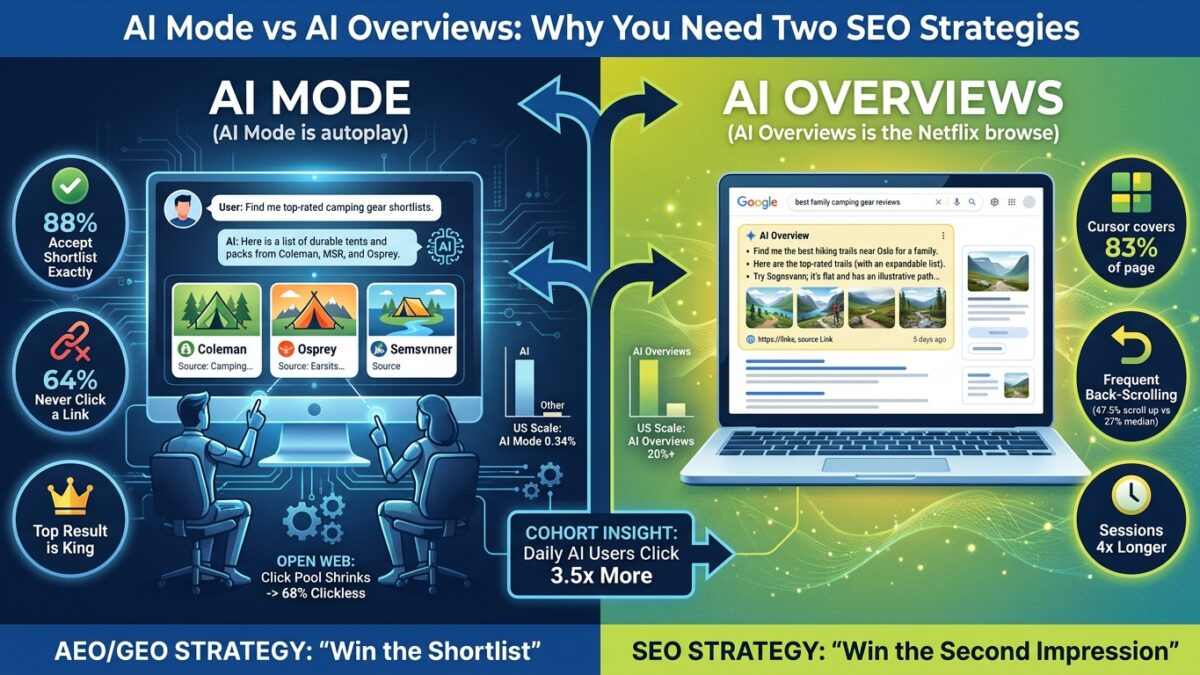
Drop a user into AI Mode and they take what they’re handed. In a study of 185 documented high-stakes purchases, 88% of tasks ended with the user accepting the AI’s shortlist exactly as given, and 64% never clicked a single link [4]. Put that same user on a results page with an AI Overview and they do the opposite: cursor sweeping across 83% of the viewport, scrolling backward almost as much as forward, re-reading listings they already passed [1].
That split comes from the largest behavioral dataset published on AI search so far, roughly 846,000 U.S. Google search sessions analyzed by Eric Van Buskirk of Clickstream Solutions for Kevin Indig’s Growth Memo [1], [2]. The conclusion is blunt: AI Mode and AI Overviews are not one “AI search” problem. They’re two different problems, and they punish you for solving the wrong one.
Table of Contents
Two surfaces hiding under one label
The industry shorthand “AI search” bundles together two surfaces that share a brand, an underlying model, and almost nothing else.
AI Overviews is the AI summary embedded at the top of a normal results page. It reaches over 2.5 billion monthly users [7] and shows up on more than 20% of searches [5]. The user never leaves the SERP. The summary, the ads, and the classic blue links all share one screen.
AI Mode is the separate, conversational search experience: a chat tab where the answer is the interface. A year after launch, Google reports 1 billion monthly users, query volume doubling every quarter, average queries three times longer than classic searches, and “which…” queries (explicit decision requests) growing 40% faster than overall AI Mode volume [8].
Scale tells you where each surface actually sits. AI Overviews touches a fifth of all searches today. AI Mode, for all its growth, still accounts for about 0.34% of U.S. search volume [5]. One is the default search experience being rebuilt in place. The other is an opt-in destination that attracts longer, more deliberate, more decision-shaped questions. Treating them as one channel is like running the same campaign on Search and Discover because both are Google.
What 846,000 search sessions actually revealed
The dataset behind all of this: anonymized clickstream from about 846,000 U.S. Google sessions, collected in February and March 2026, data via Surfer SEO [1], [2]. It measured what people physically do on a results page when an AI Overview is present. Three behaviors stood out.
- Cursors spread out. Cursor movement covers 83% of the visible page when an AI Overview is present, versus 66% without one. Users aren’t locking onto the first result. They’re surveying everything around the answer [1].
- Users stop and read. Cursor stillness, the share of time the cursor isn’t moving, rises from 29% to 44%. Sessions also run roughly four times longer. The SERP has turned into a reading session, not a scan [3].
- Half the scrolling goes backward. In the median session with an AI Overview, 47.5% of total scrolling goes back up the page, versus 27% without. Users read the AI’s answer, scroll past the listings, then circle back to re-examine them [1].
Van Buskirk’s original write-up described users who “pause, scroll, and reconsider before clicking” [2]. The validation work that used to happen by clicking out to two or three websites now happens on the results page itself.
AI Mode is autoplay
AI Mode shows the inverse pattern. In April 2026, Indig’s team documented 185 high-stakes purchase tasks inside AI Mode [4]. These were the considered, expensive decisions where you’d expect maximum comparison shopping. The results:
- 88% of tasks ended with the user accepting the AI’s shortlist as-is.
- 74% picked the item the AI ranked first.
- 64% finished without clicking any link at all.
Read that middle number again. Nearly three in four users bought, or planned to buy, whatever the machine put at the top of the list. For purchases that cost real money. I’d love to tell you people comparison-shop when the stakes go up. The data says they take the machine’s word for it.
Indig’s one-liner for the pair of behaviors is the best summary the field has produced: “AI Mode is autoplay. AI Overviews is the Netflix browse.” [1] In AI Mode, the user reads the answer, picks from inside the answer, and moves on. No back-scroll, because there’s usually nothing to scroll back to.
For visibility, that makes AI Mode a model-layer problem. The decision happens while the answer is being constructed: in retrieval, in which sources the model trusts, in whether your brand makes the consideration set at all. If you’re not in the shortlist, there is no second chance on the page. The page is the shortlist.
AI Overviews is the Netflix browse
On an AI Overview SERP, your listing isn’t competing for a single first-pass click. It gets looked at, skipped, and looked at again. Indig compares it to browsing Netflix: you hover, scroll past, come back, re-read the synopsis, and only then commit [1].
That re-read changes the job. The first impression earns the scan. The second impression, the moment the user back-scrolls to your snippet after digesting the AI’s summary, is where the click actually gets decided. For e-commerce and other high-consideration categories, your listing effectively gets two to three impressions per session, and the comparison happens on the later ones [1].
This is a SERP-presentation problem, not a model-layer problem. The user has already read an answer. Your snippet’s job has changed: it now has to give a reader with context a reason to verify, compare, or go deeper with you specifically.
Intent collapse: the signal SEO just lost
The dataset’s most uncomfortable finding is what happens to search intent. Without an AI Overview, intent predicts on-page behavior the way it has for twenty years. At 21 seconds into a session, only 12% of navigational searchers are still on the SERP, versus 32% of local searchers. A wide, readable spread. With an AI Overview present, all five intent types cluster between 41.9% and 48.5%. The spread shrinks to barely six points [3].
Indig calls it intent collapse: the AI Overview turns every session into a similar-looking reading session, regardless of why the user came. To be clear about what survives: intent still determines what content you should create, and keyword clustering still works. What’s gone is intent as a predictor of how users behave on the results page. Every dashboard and forecast that used intent type as a proxy for engagement or click propensity is now quietly wrong [3].
The collapse hits brand searches hardest, and this one stings if you manage brand campaigns. Navigational queries used to be Google’s fastest path: lowest cursor scatter (19.7), only 12% of users still on the page at 21 seconds. Under an AI Overview, scatter jumps to 27.5 and 45.8% are still there at 21 seconds [1]. People who typed your brand name, who knew exactly where they wanted to go, now sweep the page and evaluate what surrounds you before clicking. Brand recall gets you the search. It no longer guarantees you the visit.
Fewer clicks, concentrated in heavier AI users
Both behavior patterns play out inside a shrinking click pool. SparkToro’s 2026 study of Similarweb clickstream data found 68.01% of U.S. Google searches now end without any click, up from 60.45% in 2024. Fewer than one in three searches still sends one [5]. Rand Fishkin pins most of the acceleration on AI Overviews, citing Ahrefs data showing click-through rates roughly 60% lower when one is present [5]. Ahrefs’ own trend line is steep: a 34.5% CTR reduction measured in April 2025 had nearly doubled by late 2025 [6]. AI Mode, at 0.34% of searches, barely registers in the totals yet. The open web’s click problem in 2026 is an AI Overviews problem [5].
But the clicks that survive aren’t evenly distributed, and this is the part I think most strategies are getting wrong. Consumer research from GWI adds the cohort layer: among people who use AI-featured search daily, 50% click through to a cited source. Weekly or monthly users click at 28%. Rare users: 14% [7]. A 3.5x spread, pointing the opposite direction from what you’d assume. The heaviest AI users are the most likely to click out, because they’ve learned to treat the AI answer as a starting point and the cited source as the destination [7].
Put together: the total click pool shrinks, and the remaining clicks concentrate among high-frequency AI users who click citations. The surviving traffic lives in the citations.
How to optimize for each surface
The practical conclusion is that “optimizing for AI search” as a single workstream is a category error. The two surfaces need separate checklists.
AI Mode: win the shortlist
AI Mode visibility gets decided before the page renders. The work sits at the model and entity layer:
- Be retrievable and citable. Structured product and organization data, consistent entity naming, and content with specifics the model can’t generate on its own: named entities, numbers, first-hand details.
- Build third-party presence. AI shortlists lean heavily on external corroboration (reviews, comparisons, editorial mentions) rather than your own site. If the model’s sources don’t put you in the category conversation, you’re not in the shortlist.
- Monitor branded prompts. You bid defensively on brand terms; apply the same discipline here. Regularly test what AI Mode answers when asked about your brand and your category’s “which is best” questions [3]. With 74% of users taking the AI’s first-ranked item, knowing your shortlist position is the new rank tracking [4].
AI Overviews: win the second impression
AI Overview visibility gets decided on the page, during the back-scroll. Indig’s “second impression” playbook targets exactly that moment [3]:
- Product pages: Product schema with ratings, reviews, offers, and availability. Review count is now a comparison field users see twice; 47 reviews loses to 2,300 even with sharper copy.
- Category pages: ItemList schema for carousel eligibility, plus visible depth. A page with 12 products loses the implicit “is this comprehensive?” check against one with 240.
- Editorial: visible publish and update dates (a 2024 date loses to a 2026 one on the re-read), plus Article schema with a named, resolvable author.
- Titles and descriptions that survive a re-read. The user returning to your snippet has already read an answer. Front-loaded value still earns the first scan. The second pass needs a differentiator: a number, an angle, a reason you beat the summary they just read.
The paid side: the same split is coming to ads
Advertisers inherit the same asymmetry. Ads above, below, and inside AI Overviews live in the browse environment, viewed multiple times and compared against everything on the page. AI Mode’s ad formats, named at Google Marketing Live 2026, serve inside a closed loop where users rarely leave the answer. That’s closer to the one-slot, winner-takes-the-prompt dynamics of ChatGPT’s ad surface than to a classic auction for position. If your paid and organic teams treat “AI placements” as one line item, the behavioral data says they’re buying two very different products.
Stop optimizing for “AI search”
The 846,000-session study should end the era of treating AI search as a single channel. One surface is autoplay: a closed loop where the model assembles a shortlist and most users never leave it. The other is a browse: a reading session where your listing gets re-evaluated two or three times against everything around it.
The checklist version: split the workstreams. Track your presence in AI Mode shortlists through branded and category prompt testing. Rebuild your snippets and schema for the back-scroll on AI Overview SERPs. Retire intent-based engagement forecasts. Defend brand SERPs as if the click were contested, because it now is. And keep one eye on the macro numbers: with 68% of searches ending clickless, the strategies that win are built for the users who still click, and those are the daily AI users who follow citations [5], [7].
Google has made the search box two products wearing one logo. Your strategy should be at least as honest about the difference.
Sources
- Users behave differently in AI Overviews vs. AI Mode — Kevin Indig, Growth Memo
- 846,000 Google searches reveal how AI Overviews change user behavior — Eric Van Buskirk, Search Engine Journal
- What to do now that AI Overviews turned search into reading sessions — Kevin Indig, Search Engine Land
- How consumers navigate high-stakes purchases in AI Mode — Kevin Indig, Growth Memo
- In 2026, Less than One Third of Google Searches Still Send a Click — Rand Fishkin, SparkToro
- AI Overviews Reduce Clicks by 34.5% — Ahrefs
- AI Overview Click Data Reveals Unexpected User Behavior Patterns For Marketers — Search Engine Journal / GWI
- Google Reveals First AI Mode Usage Numbers After One Year — Search Engine Journal
- Users behave differently in AI Overviews vs. AI Mode (syndicated analysis) — Kevin Indig, Search Engine Land