On August 17, 2026, Google Ads starts rolling out a change to what your ROAS and CPA targets actually mean. Campaigns that are limited by budget and have quietly been beating their targets (roughly one in four target-based campaigns, according to data from PPC software firm smec [3]) will stop over-delivering. From that date, they aim for the exact number you typed into the target field.
Google calls it bidding target optimization. It’s not opt-in, there’s no toggle to turn it off, and if you run campaigns on Target ROAS or Target CPA, parts of your account are almost certainly affected [1].
Is this a welcome fix for scaling volatility, or a quiet tax on efficient campaigns? Depends on who you ask. So this article covers both sides: what Google says the change does, what independent experts say it means for your money, and what to check in your account this week.
Table of Contents
What changes on August 17
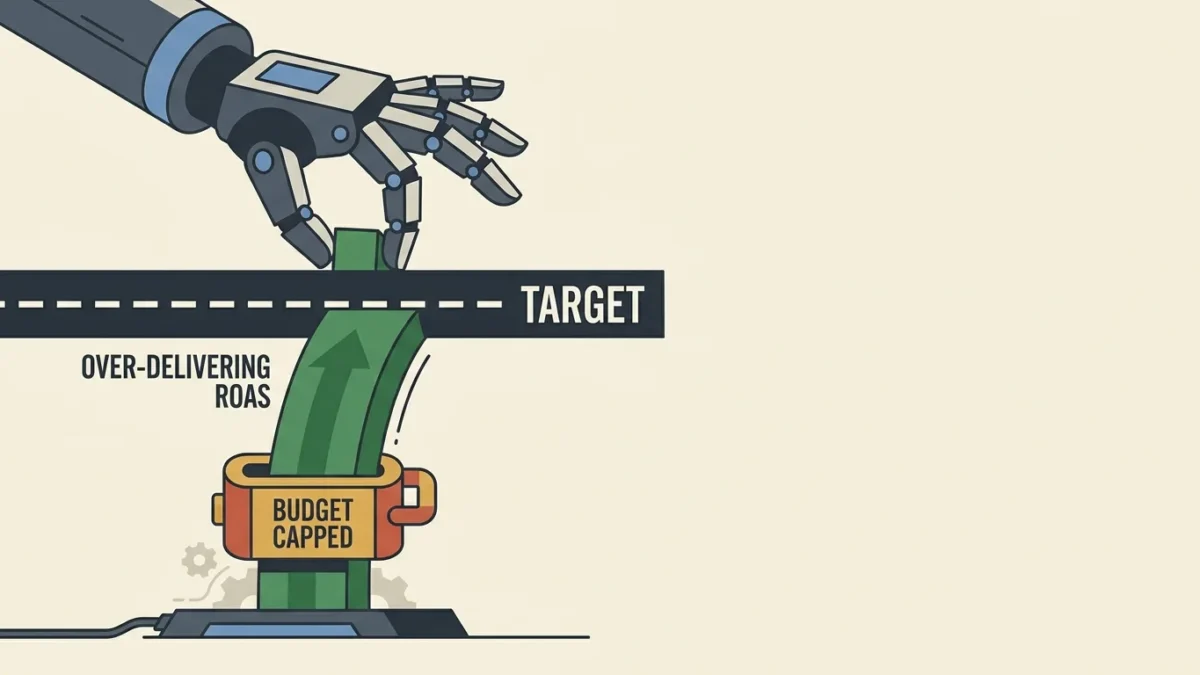
The mechanics are simple. Until now, a campaign that was limited by budget could massively over-deliver on its efficiency target. You asked for a $10 CPA, and because the budget ran out before Smart Bidding exhausted the cheap conversions, you actually got a $5 CPA. The target said one thing. Delivery said something better.
From August 17, that gap closes. Budget-limited campaigns using Target CPA, Target ROAS, and Target CPC in Demand Gen will “more consistently perform toward your bid target,” in Google’s words, regardless of budget settings [1]. A campaign asked for 5x ROAS will trend toward 5x, even if it used to deliver 8x.
One clarification Google has since given on the record: this only works in one direction. A budget-limited campaign that is underperforming its target (asking for a $100 CPA and delivering $125) gets no help from this update; the system was already trying to reach that target. Only over-achievement is being reined in [12].
The change covers Search, Shopping, Performance Max, Demand Gen and Travel campaigns, including campaigns managed through Search Ads 360 and, for Demand Gen, Display & Video 360 [11]. App campaigns and video reach and view campaigns are excluded. Hotel and Display campaigns already run on this model; Display effectively served as the pilot [4][3].
Google is applying the change automatically, and it arrives gradually from August 17 rather than landing overnight, with a recalibration period while campaigns adjust [12]. Google has said it won’t touch your targets or budgets for you, but it has been nudging: since July 6, accounts have received notifications, and a Bid Target Adjustment Tool lets you review historical performance and apply new targets in bulk before the behavior shifts [4][6].
Google’s case: your target becomes the efficiency lever
Google’s Ads Liaison, Ginny Marvin, dedicated an entire Ads Decoded episode to advertiser concerns about the update, and to be fair, the official rationale holds together [2].
The problem, as Google frames it, is volatility. When a budget-limited campaign delivers far better than its target, there’s hidden tension between what the system is achieving and what you asked for. The moment you raise the budget, Smart Bidding recalibrates from the performance it was getting to the target you actually set. Performance swings, sometimes wildly. That fluctuation “has been a source of frustration and confusion for advertisers when trying to scale their campaigns,” Marvin says [2].
After August 17 the logic becomes uniform: “In a budget-constrained campaign, the target will now be your efficiency lever” [2]. Raise the target, get more efficiency and less volume. Lower it, get more volume at lower efficiency. Budget changes should cause far less whiplash because the target steers, not the budget. Marvin is careful not to promise zero turbulence, though: budget changes will still trigger an adjustment period, just “more stable than it’s been in the past” [12].
Google is also upfront about what happens if you do nothing: the system “will aim to find conversions or conversion value at the average target that you’ve set,” which will “likely mean entering different auctions than you previously competed in” [2]. And if you want to keep your current performance, the fix is spelled out too: set your target to the average you’re actually achieving today, and after a brief recalibration you should expect similar conversion volume [2].
Notice what that last sentence concedes. Keeping what you already have now requires action.
The industry’s case: Google is collecting the slack
Independent analysts read the same announcement less charitably.
The team at smec analyzed campaigns across their client base and found something odd: Smart Bidding is structurally conservative. Campaigns with low conversion volume often miss their targets, and that share shrinks as data accumulates. But the share of campaigns that beat their target never shrinks. Regardless of conversion volume, roughly 20–25% of target-based campaigns consistently over-deliver [3]. From Google’s perspective, that over-delivery is unmonetized inventory. “Money left on the table,” as smec’s hosts put it on their Growing Ecommerce podcast [3].
Their reading of the update is a classic carrot and stick. The carrot: smoother, more predictable scaling if you open your budgets. The stick: keep the budget capped and your efficiency buffer disappears, with your actual ROAS trending down to whatever you asked for [3].
Adthena’s Joss Froggatt pushes the critique further. Many advertisers set loose targets deliberately: “A loose target was never sloppy. It was strategy” [7]. A generous target gave Smart Bidding room to explore and surface unexpectedly cheap conversions, discovery work the algorithm did on your behalf. That buffer is now being repriced.
I think both readings are true at once. The change fixes a real volatility problem, and it redirects surplus efficiency back into Google’s auction. The only question that matters for you is which side of that trade your campaigns sit on.
The mechanics: two ways your ROAS comes down
Here’s the part that deserves more attention than it’s getting. If a campaign’s budget is fixed, how does Google force a delivered 8x ROAS down to your stated 5x target? There are only two levers, and neither is pretty [3]:
- Buy worse clicks. The system deliberately enters auctions for clicks with lower expected conversion value or conversion rate, traffic it previously skipped because it wasn’t efficient enough.
- Pay more for the same clicks. The system competes in more expensive auctions, pushing your average CPC up until the efficiency lands on target.
Either way, you spend the same budget for less efficient outcomes, by design, in exchange for more volume. Google’s own framing confirms it: the campaign will enter “different auctions than you previously competed in” [2]. Whether that extra volume is worth the efficiency you give up is exactly the decision Google is now forcing you to make out loud, instead of letting the old over-delivery make it for you.
The backend trap: when platform ROAS and real ROAS disagree
There’s one scenario where this update can quietly do real damage, and it’s the one that stuck with me from smec’s client work [3].
Plenty of advertisers don’t steer by Google’s in-platform numbers at all. They calibrate against a backend source of truth: server-side tracking, an attribution model, or plain margin math. One smec client had campaigns whose in-platform over-delivery corresponded exactly to break-even in their backend data. The Google Ads interface said “beating target comfortably.” The P&L said “exactly at the water line.”
For accounts like that, the target field was never the real goal. It was a calibrated input that happened to produce the right backend outcome. When Google starts trending delivered performance down to the stated target, that calibration breaks, and the account slides below break-even while every in-platform signal reads green.
If your Google Ads targets were reverse-engineered from backend economics, treat August 17 as a forced recalibration. Your new target has to encode your actual unit economics, because Google will now deliver it literally [3][6].
What to do before August 17, and after
The good news: this is manageable if you act deliberately. A practical checklist, built from Google’s own guidance [1][2] and Optmyzr’s preparation framework [6]:
- Find the exposed campaigns — and ad groups. Filter for campaigns that are limited by budget and run Target CPA, Target ROAS or Demand Gen Target CPC. Check targets set at the ad group level too: they’re in scope, and they still override the campaign target [12]. Everything else you can leave alone. Asked bluntly whether anything at all changes for campaigns that aren’t budget-capped, Marvin’s answer was a flat “no” — if they’re performing to goal, don’t touch the targets [12][2].
- Measure the gap. Compare the set target against actual delivered CPA/ROAS over a full conversion cycle. Use the bid strategy report, not last-7-days gut feel, and look at average target performance, which folds in ad group targets, bid adjustments and value rules [12][2].
- Decide whether the gap is strategy or drift. As Optmyzr notes, the size of the gap alone doesn’t tell you which one applies [6]. A loose target you set deliberately to let the algorithm explore is different from a target nobody has reviewed since 2024.
- Pick one of four moves. Tighten the target to your recent actuals to preserve today’s efficiency. Keep the target and consciously accept more volume at lower efficiency. Raise the budget if your unit economics genuinely support scaling. Or switch to Maximize Conversions/Conversion Value if the budget is fixed and the target was only ever a proxy; per Marvin, those strategies are what’s actually designed for fixed budgets, while targets are meant to pair with uncapped ones [12][6][7].
- Use the Bid Target Adjustment Tool to apply changes in bulk, and check the in-account notifications Google has been sending since July 6 [4].
After the change lands, resist the urge to react to the first noisy days. Optmyzr’s monitoring cadence is sensible: leave the first one to three days alone, evaluate in conversion cycles rather than calendar days through day 14, correct genuine misfires in weeks two to four, then fold the check into your normal routine [6].
And if you manage seasonal accounts, get this settled well before Q4. Peak season on the new bidding regime, with targets nobody reviewed, is a bad place to find out what “the target is now your efficiency lever” means in practice [10].
The bigger picture: Smart Bidding update 2026 and the demand-led push
The August 17 change isn’t an isolated tweak. It arrived in the same June announcement as two other features, and together they show where Google is heading [1][4].
Smart Bidding Exploration, now expanding to Shopping and Performance Max, formalizes paying for discovery: you give Google permission to miss your ROAS target by a defined tolerance in exchange for new query territory. Google reports campaigns using it saw 18% more unique converting search query categories and 19% more conversions [4], plus 27% more unique converting users on Search [8].
Promotion Mode, in beta for Search and PMax, time-boxes the same idea for tentpole events: schedule a 3–14 day window, loosen the ROAS tolerance, optionally add budget, and everything auto-reverts when the sale ends [9].
Add the announced demand-led budget pacing and you get the picture: Google wants budgets uncapped and demand-responsive, with your target as the single steering input. These are the themes it laid out at Google Marketing Live 2026. Every one of these features either removes a reason to cap budgets or puts a price on the exploration that loose targets used to buy invisibly.
Which also means campaign structure does more work than before. If distinct product groups or funnel stages need genuinely different efficiency levels, they now need their own campaigns with their own honest targets. The average across a mixed campaign is exactly what Google will deliver. Demand Gen advertisers should pay particular attention, since Target CPC is in scope there too; if you’re mid-migration from Display, our Display-to-Demand-Gen migration guide covers the structural side.
The takeaway
Strip away the reassuring official framing and the cynical hot takes, and the August 17 bidding change comes down to one sentence: your target is now a promise Google will keep literally.
For years, budget caps and loose targets let advertisers steer Smart Bidding indirectly, and the system’s conservative streak paid out a quiet efficiency dividend to about a quarter of all target-based campaigns. That era ends this week. The advertisers who get hurt won’t be the ones with the biggest target gaps. They’ll be the ones who never knew the gaps existed.
So do the unglamorous thing. Pull the list of budget-limited campaigns, compare targets to reality over a full conversion cycle, and set every target to a number you’d defend in front of your CFO, grounded in backend economics rather than platform screenshots. Then let the system recalibrate, and judge it in conversion cycles, not mornings.
Google has told you exactly what it’s about to do. The only mistake left is not answering.
Sources
[1] Bidding and budgeting updates to scale your growth — Google Ads. https://business.google.com/us/accelerate/announcements/bidding-and-budgeting-updates-to-scale-your-growth/
[2] Community Q&A: August 17 bidding update — Ads Decoded, Google Ads (Ginny Marvin). https://www.youtube.com/watch?v=tqp-pQkKLT4
[3] Google’s Smart Bidding Change: Why Your ROAS Is About to Drop — Growing Ecommerce podcast, smec (Mike Ryan & Christian Scharmüller). https://www.youtube.com/watch?v=2HPmk2OCy3M
[4] Google Ads gets promotion mode and a major bidding overhaul this August — PPC Land (Luis Rijo). https://ppc.land/google-ads-gets-promotion-mode-and-a-major-bidding-overhaul-this-august/
[5] Google explains what advertisers should expect from Smart Bidding changes — Search Engine Land (Anu Adegbola). https://searchengineland.com/google-explains-what-advertisers-should-expect-from-smart-bidding-changes-484410
[6] Google’s August 17 Bidding Change: What Advertisers Need to Do Now — Optmyzr (Vimal Bharadwaj). https://www.optmyzr.com/blog/google-ads-august-2026-bidding-update/
[7] The Google Ads bidding change: what to do now — Adthena (Joss Froggatt). https://www.adthena.com/resources/blog/the-google-ads-bidding-change-what-to-do-now/
[8] Google Marketing Live 2026: bidding and budgeting news — Google. https://blog.google/products/ads-commerce/bidding-budgeting-google-marketing-live-2026/
[9] Google’s Promotion Mode is live (Beta) — smec (Manuel Baudisch). https://smarter-ecommerce.com/blog/en/google-ads/google-promotion-mode-is-live-in-beta/
[10] The 2026 Q4 Playbook: Scale Google Ads Through the Holiday Peak — smec webinar (Mike Ryan). https://www.youtube.com/watch?v=pH-6MXA_Ogs
[11] Changes to target based bid strategies — Google Ads Help. https://support.google.com/google-ads/answer/17061251
[12] Interview with Ginny Marvin: Deep Dive on Limited By Budget Targets & the Aug 17 Google Ads Changes — Marketing O’Clock (Greg Finn). https://www.youtube.com/watch?v=iofOki6Zy8U