ChatGPT Ads will tell you, to the individual conversion, exactly what your own money did. It will tell you almost nothing about the auction you just spent it in. That asymmetry is not a gap waiting for a product update to fill. It looks like the design.
On 24 July 2026, OpenAI announced the largest set of changes to its ad platform since launch: conversion-optimised campaigns, average daily budgets, automatic intraday pacing, geographic exclusions, mobile measurement integrations, Automatic Advanced Matching, and asynchronous bulk operations in the API [1]. Every item on that list improves how well an advertiser can measure and control their own account. Not one of them tells an advertiser anything about a competitor.
Stated plainly, before any budget decision: ChatGPT Ads is currently the most self-measurable and least externally observable major ad surface in performance marketing. For a full account of what the platform is, which markets it runs in, and how the formats work, there’s a complete guide to ChatGPT Ads for advertisers. This piece takes a narrower question with bigger consequences: what you can see, what you can’t, and what to do about the difference.
Table of Contents
What OpenAI gives advertisers
The advertiser-side measurement stack is good, and it was built early rather than retrofitted. When OpenAI first signalled a move from brand advertising into performance formats, the reported plan included pay-per-action pricing, an OpenAI ad pixel for post-interaction tracking, and API-based conversion tracking that lets advertisers send conversion and customer data back to the platform directly [4][5].
Two of those three arrived. Pay-per-action did not: the Conversions objective that actually shipped in July optimises toward conversions while continuing to charge per click [1]. That gap is worth holding onto, because a platform that bills for clicks while optimising for conversions is asking the advertiser to carry the prediction risk.
The API-first choice matters more than it sounds. Google and Meta both spent years bolting server-side measurement onto pixel architectures designed for a browser environment that no longer exists. OpenAI started after that problem was already well understood, so it built for the post-pixel world from the beginning. An advertiser wiring ChatGPT Ads into a CRM today is not working around a legacy tracking model.
July’s release extended that stack in four directions:
- Conversion-optimised campaigns. A new Conversions objective creates optimised cost-per-click campaigns that steer toward clicks more likely to convert, while still charging on a CPC basis [1].
- Automatic Advanced Matching. Hashed customer data improves conversion attribution for website events, enabled under Tools, Conversions, Data Source.
- Mobile measurement. Integrations with AppsFlyer and Adjust make app installs and in-app events measurable from ChatGPT Ads campaigns.
- Budget behaviour advertisers expect. Automatic intraday pacing, plus a shift from hard daily caps to average daily budgets over a rolling seven-day period, which OpenAI said would begin the following week.
Read as a list of capabilities, this is a platform maturing on schedule. Read against what publishers get from the same company, it is something else.
What everyone else gets
A website owner whose content is being used to construct ChatGPT’s answers has exactly one control: allow the crawler, or disallow it. There is no impression report, no query data, no citation count, and no referral attribution beyond whatever survives in analytics.
Duane Forrester’s framing of this is the sharpest available, and it turns on a piece of history worth revisiting [2]. In 2011 Google encrypted organic search keywords into the “not provided” bucket, withholding query data from site owners while continuing to give paid advertisers rich conversion reporting. Same user, same intent, different monetisation, asymmetric disclosure. The industry reaction was loud and lasted years.
The lesson platforms drew from that episode, in Forrester’s reading, was not “don’t withhold data.” It was that taking access away costs years of goodwill, so it is safer never to grant it. Applied to a new surface, that produces exactly what ChatGPT looks like today: a full server-to-server conversion pipeline with pixel and event APIs for buyers, and a robots.txt file for everyone else.
His observation about why this generates so little protest is the part to keep. A designed absence produces no organised complaint, only a vague and unfocused unease. Nobody can point to the moment their data was removed, because it never existed.
This has a direct consequence for anyone weighing whether to block AI crawlers. Roughly 80% of AI bot activity is training-related rather than the retrieval traffic that generates citations, which means blocking is really two decisions being made as one [11]. And no public study has yet established how much citation share a site actually loses by restricting a specific bot. The honest position is that the trade-off is real and unquantified.
The auction you cannot see
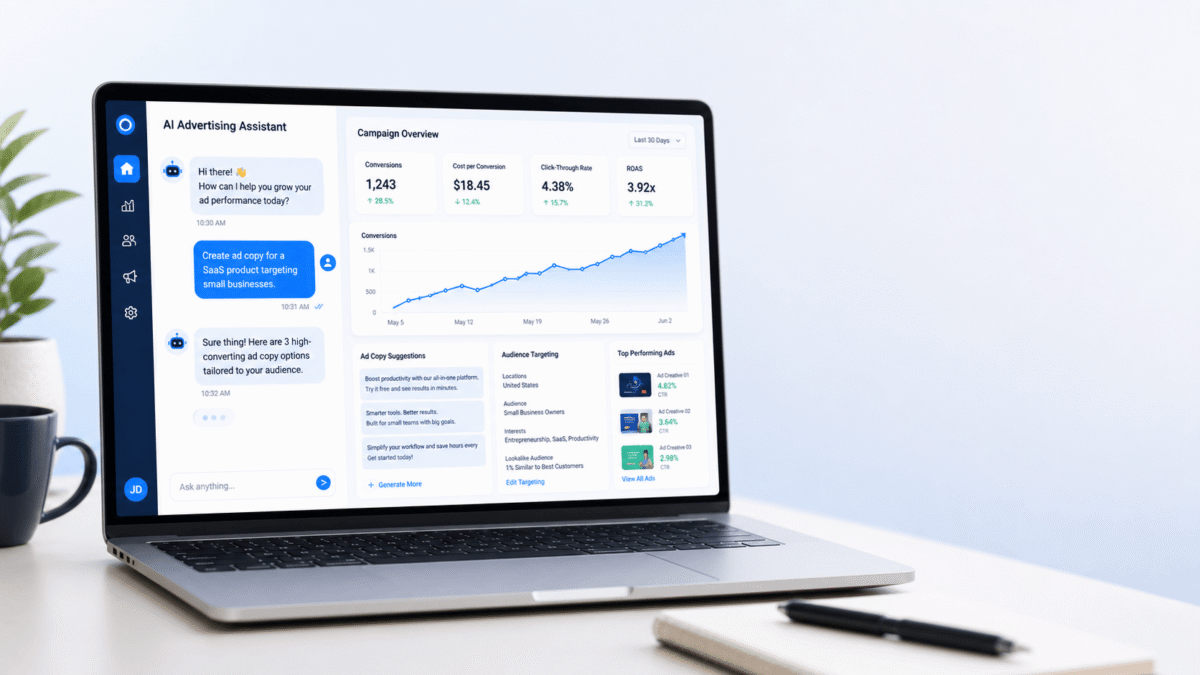
The advertiser-side blind spot is narrower than the publisher’s but sits in a more expensive place. OpenAI’s native Ads Manager shows an advertiser their own spend, impressions, clicks, CPC and CTR. It does not show competitor visibility, an Auction Insights equivalent, a share-of-voice view, or any read on which prompts trigger rival ads [3].
In Google, that would be an annoyance. Here it compounds with a structural feature of the surface. An analysis of roughly a million indexed queries across five markets, published by a competitive-intelligence vendor, found that ad-bearing responses in the United States average 1.06 ad items, which is effectively one sponsored slot, with no carousel and no second position [3].
Share of voice on this surface is therefore binary. You are in the answer or you are absent. There is no gradient to occupy, no value in holding position three, and no partial credit. That changes what invisibility costs. On a Google results page, losing the top slot means fewer clicks. Here it means none.
The same dataset established two other facts that bear on measurement. Ad coverage is concentrated in the United States, which accounts for around 90% of placements, with US query ad-coverage near 4.5% and the UK returning effectively no ads at all. And the vertical mix does not match intuition: against a platform average near 3.3%, logistics ran at 12.4%, home and garden at 12%, beauty and cosmetics at 10%, while legal, pharmaceutical, banking and nonprofit returned zero ads and healthcare sat at 0.45%. Retail and fashion over-indexed hardest, taking 39% of US ad items from 24% of query volume.
Those numbers are only knowable because a third party went and measured them. None of it appears in the platform’s own reporting.
Why conversion bidding raises the stakes
Until July, an advertiser buying ChatGPT Ads was buying clicks. The blind spot was uncomfortable but the exposure was bounded, because a CPC campaign with a fixed daily cap can only lose so much before someone notices.
Conversion optimisation changes the shape of that exposure. An optimiser works by moving spend toward whatever it predicts will convert, so it concentrates budget rather than spreading it. In a gradient auction that concentration is observable: impression share falls, average position drifts, and Auction Insights shows who took the ground. In a one-winner auction with no competitive reporting, the same concentration produces a number that looks like performance, with no way to tell whether it reflects a better match or a competitor who happened to stop bidding.
Add average daily budgets to that. Once that shift lands, spend fluctuates day to day within a rolling seven-day window, which is standard and sensible on every mature platform, and which also removes the daily hard stop that previously worked as a crude circuit breaker.
None of this argues against using conversion bidding. It argues that the diagnostic burden moves onto the advertiser. On Google, the platform tells you when you lost. Here, the only signal that something changed is a shift in your own numbers, and the only interpretation available is the one you construct yourself.
The third-party market is the tell
A useful way to judge how serious a data gap is: check whether anyone has built a business filling it.
They have. Competitive intelligence tooling for ChatGPT Ads now monitors hundreds of thousands of prompts daily to reconstruct competitor share of voice and surface prompts nobody is bidding on yet [3]. Separate tooling exists specifically to let advertisers see competitor ads inside ChatGPT [7].
Both are reconstructions built by sampling prompts at scale from outside the platform. That is an expensive way to obtain information the auction operator already holds, and the existence of a market for it is the clearest evidence that the omission is material rather than cosmetic. Auction Insights, by comparison, is free.
A second-order effect follows. When competitive data is only available by purchase, competitive advantage accrues to whoever buys it, which tends to be the larger advertiser. On a surface whose own pitch has been aimed at smaller advertisers and appointment-based local businesses [4], that is an awkward distribution.
The answer is built from data you do not control
Measurement blindness would be easier to accept if the inputs to the answer were things an advertiser could influence. Increasingly they are not.
In July 2026, Yelp licensed its reviews, ratings, photos and business information to OpenAI, giving ChatGPT real-time local recommendation data [8]. Yelp branding and links appear when its content is used, but OpenAI controls how that is presented. Yelp’s Request a Quote feature is also coming to ChatGPT local services searches, so a lead-generation action can complete inside the conversation without the user reaching the business’s website.
For a local business, that shifts the visibility question. It stops being only whether the website is readable and becomes whether the third-party record is accurate, which is a different workstream and one most advertisers do not own. It also removes a measurement surface: a quote request that never touches your domain leaves no analytics trace at all.
Product feed ads point the same way. Retail advertisers can upload full catalogues and have ads generated from individual items during purchase-focused conversations, and OpenAI has described feed-based ads as among its strongest-performing formats [6]. The feed is an input the advertiser fully controls. How it gets assembled into an answer is not.
This is the same mechanism that governs unpaid AI visibility, where citations are an output of a retrieval process rather than a lever to pull directly, an argument developed at length in how AI actually decides which brands to recommend. Paid placement changes who pays for the slot. It does not change who assembles the answer.
Google is doing a politer version of the same thing
It would be convenient to treat this as an OpenAI problem that a more mature competitor eventually solves. The evidence does not support that.
Google’s AI visibility reporting has been expanding through 2026: generative AI performance reports in Search Console showing impressions by page, country, device and date, currently piloting in the UK, and an AI Performance insights report in Merchant Center, also in pilot, covering how brands appear in AI Mode and AI Overviews [9]. The Merchant Center report even includes a competitive share-of-voice view, which is more than any other Google surface offers. Both are pilots, so for most advertisers this is still a description of what is coming rather than something to open today.
What both reports withhold is clicks. Individual queries are unavailable, grouped question categories replace search terms, and the competitor set is neither disclosed nor customisable. Impressions confirm that a link appeared. They cannot establish whether anyone arrived.
The selection is not arbitrary. Impressions are the metric that necessarily grows as AI surfaces expand. Clicks are the metric that may not.
The same asymmetry showed up in Alphabet’s Q2 2026 disclosures, where Search and other revenue was reported as $63.27 billion, up 17% year on year, the first deceleration after four consecutive quarters of acceleration [10]. Traffic, by contrast, was described in three kinds of claim that cannot be checked: usage superlatives such as queries being at an all-time high, volume claims about billions of clicks sent weekly with no denominator and no split between AI and traditional results, and quality claims that AI Overviews mostly remove low-value clicks while organic volume stays relatively stable, offered without a published baseline.
Revenue is stated to the decimal because securities law requires it. Traffic is described in adjectives because nothing requires otherwise. The two platforms differ in politeness, not in principle, a pattern that also runs through how AI ad surfaces handle disclosure and transparency obligations.
Three measurement problems you can own
The productive response is to stop treating this as one problem called “AI visibility measurement” and separate it into three, none of which needs platform cooperation [2].
1. Referral attribution
Identify traffic arriving from AI answers using classification rules that combine referrer data with landing-page patterns, and tag every link you control. This is unglamorous configuration work, it is entirely within an advertiser’s gift, and most accounts have not done it. It will not capture everything, since a conversation that ends without a click leaves nothing to attribute, but it establishes a floor.
2. Incrementality
Run controlled experiments: holdout geographies, on-off tests, before and after content analysis. This is the only method on the list that produces a causal number rather than a correlation, and it is the correct answer to “is ChatGPT Ads working.” Geographic holdouts are unusually practical here, given that the surface is heavily concentrated in the United States and effectively dark in several markets. The geography is doing half the experimental design already.
3. Dark-funnel influence
Use self-reported attribution surveys and branded-demand correlation, methods borrowed from B2B practice, where long unobservable buying cycles have been normal for decades. A source-of-discovery field on the enquiry form is a crude instrument, and it is also the only one that captures a recommendation delivered in a conversation the advertiser never saw.
The common thread is that credible measurement here closes the loop with data the advertiser already owns. Any vendor whose pitch depends on privileged access to platform internals is selling a reconstruction, and it should be priced as one.
What the evidence supports doing now
Four things follow from the material above, in rough order of cost.
- Fix referral classification before funding the channel. Spending on a surface you cannot attribute is a decision to generate unreadable data. This is hours of work, not weeks.
- Treat the conversion objective as an experiment with a stated hypothesis. Write down what you expect before switching it on. In an auction with no competitive reporting, a documented prior is the only thing that separates a result from a coincidence.
- Design one geographic holdout. The concentration of ad coverage in the United States makes a clean control unusually easy to build, and incrementality is the only measurement on the list that answers the question a finance team will actually ask.
- Audit third-party records, not only your own site. Once licensed review data feeds local answers and quote requests complete inside the conversation, the accuracy of a directory listing becomes a performance input.
What the evidence does not support is waiting for the reporting to improve. The advertiser-side stack has developed quickly, which shows OpenAI can ship measurement when it chooses to. Competitive transparency has not moved at all in the same period, and on the historical pattern it is unlikely to arrive later, because a capability never granted generates no pressure to grant it.
The reasonable working assumption is that this is the steady state rather than an early-stage inconvenience. Budget accordingly, measure what you own, and treat every number the platform reports about itself as a claim rather than a finding.
Sources
1. ChatGPT Ads adds conversion bidding, geo exclusions and bulk campaign tools — Search Engine Land, 24 July 2026
2. Google went ‘not provided’ in 2011 and blinded us, ChatGPT just shipped its version — Search Engine Journal, 23 July 2026
3. What ChatGPT Ads data reveals about your competitors — Search Engine Land, 8 June 2026
4. OpenAI is preparing conversion-focused ads for ChatGPT — Search Engine Land, May 2026
5. OpenAI confirms conversion-focused ads are coming to ChatGPT — Search Engine Land, May 2026
6. OpenAI launches product feed ads in Ads Manager beta — Search Engine Land, 11 June 2026
7. See competitor ads in ChatGPT — Search Engine Journal
8. ChatGPT gains access to Yelp reviews, ratings, and photos — Search Engine Land, 23 July 2026
9. Google’s AI search data is growing, but the gaps remain — Search Engine Journal, 21 July 2026
10. Google’s Q2: precise revenue figures, click claims you can’t check — Search Engine Journal, 25 July 2026
11. Charging AI bots decides which agents can still cite you — Search Engine Journal, 25 July 2026